Chiang Mai Live Music Scene: Thai Bands, Artists & Venues
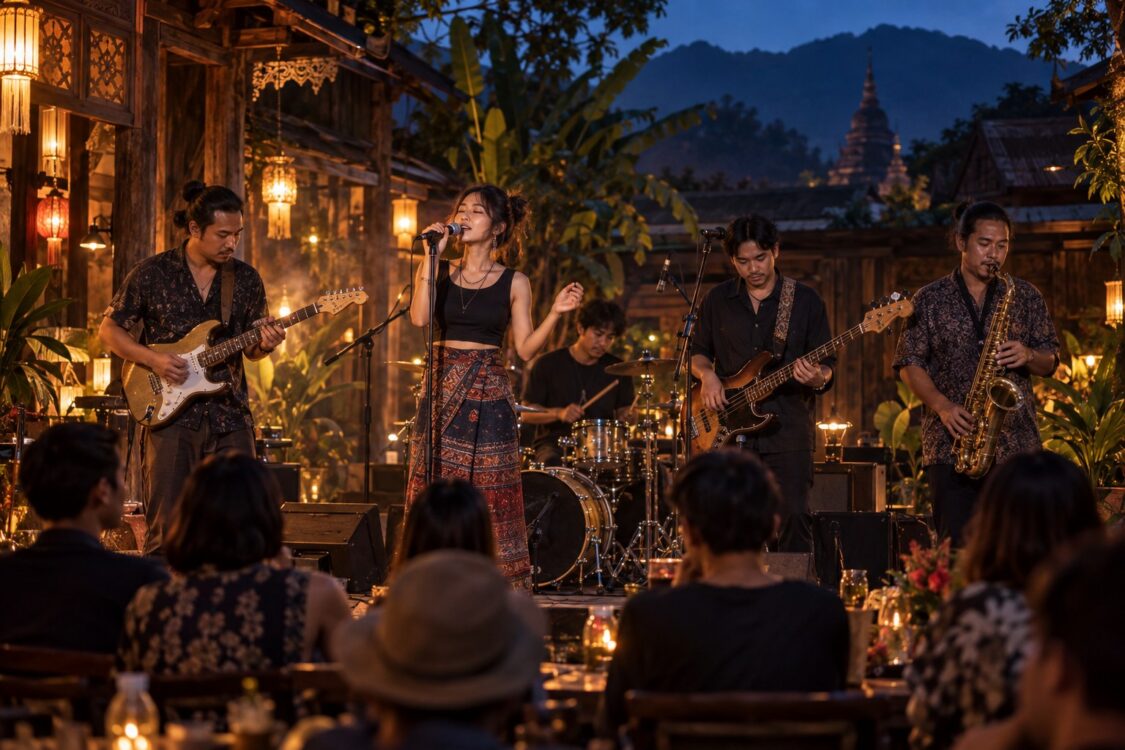
After dark, Chiang Mai does not sound like one city. Jazz pours through the open front of a crowded bar near Chang Phuak Gate. A few streets away, a guitarist is setting up in a courtyard for an audience that may not yet know the band’s name. Along the Ping River, polished house bands work through Thai rock classics while diners order another round.
The distances between these places are short, but they belong to different musical worlds. Chiang Mai has intimate jazz clubs, indie stages, blues bars, restaurant bands, student concerts and performances rooted in northern Thai culture. Much of it happens in rooms holding fewer than a hundred people.
That smaller scale gives the Chiang Mai live music scene its character. Musicians cross paths repeatedly, sit in with one another and appear under different band names from week to week. A visitor who follows only nationally advertised concerts will miss most of what the city does best.
Discover a wide variety of Thai Music on the Ajarn David Radio playlist on Spotify.
How Chiang Mai’s Music Scene Took Shape
Chiang Mai is Thailand’s largest northern city and home to several universities, including Chiang Mai University, Maejo University, and Rajamangala University of Technology Lanna. The steady arrival of students has helped maintain an audience for affordable concerts, original bands and late-night bars outside the tourist districts.
The city also attracts artists who prefer to work away from Bangkok. Rent and rehearsal costs have traditionally been lower, while the café, gallery and small-venue culture gives musicians places to perform without waiting for a national promoter. Some eventually move south to pursue larger opportunities. Others remain in Chiang Mai and tour when a new release gives them a reason to travel.
Jazz developed an especially visible presence. North Gate Jazz Co-Op became the center of a community that now extends across several clubs and an annual street jazz festival. Indie rock followed a different route through university audiences, independent labels, cafés and multipurpose venues such as Thapae East.
The result is not a northern version of Bangkok nightlife. The Bangkok live music scene has more large concert halls, label showcases and stops by national touring acts. Chiang Mai depends more heavily on small rooms and repeat audiences.
It also differs from live music in Isaan, where mor lam, luk thung and regional festivals occupy a more central place, and from Phuket’s live music scene, which is shaped to a greater degree by beach venues, international visitors and the island’s hospitality industry.
Jazz at the North Gate
North Gate Jazz Co-Op
North Gate Jazz Co-Op is the first name most people hear when asking about live jazz in Chiang Mai. The club stands on Si Phum Road near Chang Phuak Gate, at the northern edge of the Old City. Its narrow interior fills quickly, leaving late arrivals clustered around tables and stools outside.
The lack of space has become part of the experience. Musicians perform only a few feet from the front row, and people on the pavement peer through the open entrance. There is none of the physical separation found in a hotel lounge or formal concert hall.
North Gate is called a co-op for good reason. Its reputation was built through a community of resident musicians, visiting players and open sessions rather than a single permanent house band. A set might begin with a planned quartet and end with additional musicians taking turns onstage.
The music is broader than the name “jazz bar” suggests. Bebop and standards remain part of the program, but funk, blues, Latin jazz, fusion and improvised rock also appear. The musicians determine the direction of the night.
This 2025 performance by Sun Der captures the setting better than a description of it can. The band is close to the audience, the stage is modest, and the performance depends on the players rather than elaborate production.
North Gate Spirit
North Gate Spirit grew from the same musical circle but is not simply an overflow room. It gives musicians another stage and allows the community around North Gate to support more performances than one small venue could handle.
The two spaces are close enough to make a North Gate evening flexible. If one room is full or its lineup does not appeal, the other may have a different group playing. During larger jazz events, both become part of the same network of stages.
Chiang Mai’s Other Jazz Clubs
The Mellowship Jazz Club
The Mellowship offers a more composed night out than North Gate. There is a defined stage, proper seating and a schedule built around complete performances rather than the possibility of a spontaneous street crowd.
The club has hosted local musicians as well as international guests, with programs covering bebop, post-bop, fusion, funk and soul jazz. In 2026, it was one of five venues used for Chiang Mai’s International Jazz Day celebrations, alongside North Gate Jazz Co-Op, North Gate Spirit, Moment’s Notice and Mahoree City of Music.
The difference between The Mellowship and North Gate is not one of quality. It is a difference in setting. At The Mellowship, an audience can settle in and follow an arranged set from beginning to end. North Gate feels more likely to change shape while the night is underway.
Moment’s Notice Jazz Club
Moment’s Notice takes its name from the John Coltrane composition first recorded for the 1957 album Blue Train. The reference suits a club that leans toward focused listening and musicians comfortable with jazz history.
Its intimate size works particularly well for trios and quartets. Piano, bass and drums do not have to fight against a dining room full of conversation, while quieter solos remain audible. The audience is close enough to notice how musicians communicate through eye contact and small changes in rhythm.
Mahoree City of Music
Mahoree City of Music is harder to reduce to a single genre. The name refers to mahori, a form of Thai classical ensemble, but its programming extends into jazz and contemporary performance.
It fits Chiang Mai’s broader arts culture better than a conventional bar category. A night at Mahoree may involve an experimental ensemble, an unusual collaboration or players approaching jazz from outside the standard club repertoire. Its participation in Chiang Mai’s 2026 International Jazz Day program confirmed its place within the city’s expanding jazz circuit.
Chiang Mai Street Jazz Festival
The Chiang Mai Street Jazz Festival began in 2019 and reached its sixth edition in December 2024. By 2025, the event had expanded into a week-long program held from December 1–7.
The festival does not remove jazz from the clubs and place it behind a distant barricade. It uses the venues, musicians and neighborhoods that support the scene during the rest of the year. Performances have appeared at jazz clubs, cafés and street-facing spaces around the city.
That structure allows smaller groups to share the program with established musicians. It also gives listeners a reason to visit rooms they might otherwise overlook. One evening might include a young local ensemble in a café, followed by a more experienced band at North Gate or The Mellowship.
The festival schedule changes each year. December visitors should check announcements from Chiang Mai Street Jazz rather than relying on a previous program.
International Jazz Day in Chiang Mai
In 2026, Chiang Mai marked International Jazz Day with three days of music from April 30 through May 2. Five venues participated: The Mellowship Jazz Club, Moment’s Notice Jazz Club, Mahoree City of Music, North Gate Jazz Co-Op and North Gate Spirit.
Performances ran from the afternoon until midnight, with free admission across the participating venues. Instead of building one large temporary stage, organizers encouraged the audience to move through the city’s existing jazz network.
The program also showed how much the scene had grown beyond North Gate. The city now has enough active rooms to support simultaneous performances with different styles, from bebop and post-bop to blues, funk and experimental jazz.
Original Music at Thapae East
Thapae East occupies a different place in Chiang Mai’s music history. Its outdoor courtyard and adaptable stage have hosted indie rock, folk, jazz, funk and touring artists who do not fit naturally into a restaurant or nightclub.
The venue is east of the Old City near the Tha Phae area. Concerts here feel more like individual events than part of a nightly entertainment schedule. Some attract an audience specifically for the headliner; others draw people who recognize only one band on a multi-act bill.
That distinction is important. Chiang Mai has no shortage of bars offering familiar cover songs, but original artists need rooms where the audience expects unfamiliar material. Thapae East has repeatedly provided that kind of stage.
Its calendar is not identical every week. Anyone planning to visit should first check the announced lineup rather than assuming a concert will be taking place.
Boy Blues Bar and the Night Bazaar
Blues has maintained its own foothold in Chiang Mai through Boy Blues Bar. The venue is associated with guitarist and singer Boy, whose performances helped make it a recognized stop within the Night Bazaar area.
The bar is direct and unpretentious. Electric guitar leads the music, with blues standards, classic rock and long solos forming much of the repertoire. The playing is loose enough to leave room for guest musicians and interaction with the audience.
Boy Blues Bar does not try to imitate an American blues club with carefully manufactured décor. Its identity comes from the musician at the center of it and the people who return to hear him play. That personal connection separates it from the many bars in tourist districts where bands are treated as interchangeable background entertainment.
Riverside Bands and Thai Nightlife
The Riverside Bar & Restaurant
The Riverside Bar & Restaurant has operated beside the Ping River since the 1980s and remains one of Chiang Mai’s best-known combinations of dinner and live music. It is larger and more commercial than the city’s indie rooms, but it represents an important part of local nightlife.
House bands move between Thai rock, pop, dance songs and international hits. The set is built around recognition and momentum. A singer who can shift from a Thai ballad to an English-language rock song is more valuable here than a group determined to perform only original material.
The audience is mixed. Local groups celebrate birthdays beside travelers who arrived after reading about the riverfront. As the evening advances, attention moves away from the tables and toward the stage.
The Good View
The Good View also combines riverside dining with bands and late-night socializing. The name has become familiar in more than one Thai city, but the Chiang Mai location remains closely associated with the Ping River nightlife district.
Music here is part of a complete evening rather than a self-contained concert. Bands work with a broad repertoire because the room contains several audiences at once: diners, regular customers, groups marking an occasion and visitors hearing Thai pop for the first time.
These riverfront venues reveal which older songs still occupy a place in Thai popular memory. A hit from years ago may receive a louder response than a current release because everyone at the table knows the chorus.
Warm Up Café
Warm Up Café opened in 1999 and became one of Nimmanhaemin Road’s most durable nightlife businesses. Its longevity is notable in a district where restaurants and clubs regularly change names.
Warm Up combines live bands with DJs and dance-oriented rooms. Early sets are more likely to feature pop-rock and recognizable Thai songs; later hours move toward club music. The audience is predominantly Thai and has long included university students, young professionals and Chiang Mai residents celebrating in groups.
This is not a listening room. People talk, drink, move between areas and join the chorus when a favorite song begins. Anyone seeking the social side of Chiang Mai live music will understand the appeal quickly.
Sudsanan Chiang Mai
Sudsanan follows the Thai restaurant-and-band tradition: shared dishes, bottles on the table and singers performing songs the audience already knows. Thai rock and emotional pop ballads carry more weight here than jazz improvisation or English-language indie music.
Foreign visitors sometimes overlook this branch of the live music scene because it is not designed specifically for tourists. Yet it offers a useful lesson in Thai popular taste. The loudest reaction in the room identifies the songs that have remained part of people’s lives long after their original release.
Discover the best Indie bands in Thailand in this Spotify playlist.
Chiang Mai Indie Bands and Artists
YONLAPA
YONLAPA emerged from Chiang Mai’s working bar circuit rather than an audition or Bangkok label project. Before the group formed, its four members were performing separately in Chiang Mai music venues and repeatedly encountered one another at shows.
Singer and guitarist Yonlapa “Noina” Pienpanassak brought together guitarist Arnuphap “Gun” Foeilung, bassist Nawin Raknaisil and drummer Chalanthorn “Fewchy” Soontornpitak. With no band name settled, they used Noina’s first name.
YONLAPA released music in 2019 and developed an audience through songs that combine dream pop, indie rock and psychedelic guitar. The lyrics are often in English, but the band’s identity is firmly connected to Chiang Mai. Its members chose to remain in the city rather than treating relocation to Bangkok as an automatic step toward success.
“Let Me Go” shows why the band traveled well beyond its hometown audience. The English lyrics are immediately accessible, while the guitar tone and unhurried arrangement retain the atmosphere of the Chiang Mai scene in which the members met.
In July 2025, YONLAPA released “Saltburn,” the first single from a new EP project. By then, the group had performed outside Thailand and become one of the most internationally visible bands to emerge from Chiang Mai’s independent circuit.
More groups working beyond Thailand’s mainstream pop industry appear in this guide to Thai indie music and artists.
Solitude Is Bliss
Solitude Is Bliss belongs to an earlier wave of Chiang Mai alternative rock. The group became known for dense guitars, changes in intensity and Thai lyrics that carried more ambiguity than a conventional radio ballad.
The band’s rise helped demonstrate that an alternative group could build a serious following while being identified with Chiang Mai rather than Bangkok. Its songs traveled through online listening, festival appearances and word of mouth among Thai indie audiences.
Onstage, the contrast between restraint and release is central to the band’s sound. Quiet passages create space before the guitars gather force, giving the songs a dramatic shape that is less obvious when heard casually in the background.
Sun Der
Sun Der is tied to Chiang Mai’s jazz community through performances at North Gate Jazz Co-Op and the Chiang Mai Street Jazz Festival. The group draws on jazz vocabulary without presenting itself as a museum piece.
Rhythm is central to its appeal. Funk, groove-based passages and improvisation make the music approachable for listeners who do not follow traditional jazz. The 2025 North Gate performance embedded above shows a band playing to a local crowd in the setting where this music has developed.
Chiang Mai Blues and Kalio & the CM Crew
Not every important name in Chiang Mai operates like a conventional band with a fixed lineup and carefully spaced releases. Chiang Mai Blues and Kalio & the CM Crew belong to the city’s more fluid network of working musicians.
The same players reappear in blues, jazz and funk lineups around town. A guitarist heard in one ensemble may return several nights later behind a different singer. Clubs such as The Mellowship publish the current lineup because the combination of musicians is part of the attraction.
This overlap explains why Chiang Mai’s scene feels connected despite being spread across several neighborhoods. The bands change, but the players recognize one another.
CGM48
CGM48 represents the organized pop industry rather than the small-club circuit. The group was announced in Chiang Mai on June 2, 2019, as a sister group to BNK48 and part of the wider AKB48 idol-group system.
Its first audition was held from June 15 to July 15, 2019. The debut single, “Chiang Mai 106,” followed in February 2020. The title refers to Route 106, which passes through northern Thailand, giving the new group a geographic identity from its first release.
CGM48 performances combine recorded pop songs, choreography, costumes and direct interaction with fans. Their showcases bear little resemblance to a North Gate jam or a Thapae East indie concert, but they demonstrate that Chiang Mai also supports a locally based branch of Thailand’s national pop business.
Northern Thai and Lanna Music
Long before Chiang Mai had jazz clubs or indie bands, northern musicians played instruments associated with Lanna culture. The sueng is a plucked string instrument with a rounded wooden body. The salo is bowed, while the pi jum is a free-reed pipe used in northern ensembles.
Traditional performances are still heard at temple fairs, cultural centers, community celebrations and seasonal festivals. Some hotel and dinner shows present shortened arrangements for visitors, while local ceremonies place the music in a social or religious setting.
The instruments have not remained sealed within traditional performance. Northern musicians use Lanna melodies and timbres in folk, rock, jazz and experimental projects. A sueng may appear beside an electric guitar, or a familiar regional melody may become the basis for improvisation.
This performance shows how Lanna music continues to develop rather than surviving only as a reproduction of the past. Traditional northern sounds are placed within a contemporary arrangement intended for a modern audience.
These combinations make more sense when the regional traditions are understood on their own terms. The broader guide to Thai music genres explains how northern music differs from styles such as luk thung and mor lam.
Festivals and Seasonal Performances
Jazz has the city’s clearest recurring festival structure, but it is not the only music heard at public events. Chiang Mai’s university calendar produces student showcases, faculty concerts and performances connected with arts programs. These are among the better places to hear young musicians before they join established club lineups.
Loy Krathong and Yi Peng bring temporary stages to the city in November. Music shares the program with lantern displays, dance, parades and religious observances, so these celebrations should not be confused with dedicated music festivals. Still, they provide opportunities to hear northern ensembles and mainstream Thai performers in public spaces.
Temple fairs follow their own local schedules. A fair might feature traditional music early in the evening and a contemporary band later. Announcements are commonly made in Thai through community pages and posters rather than English-language event websites.
Travelers arranging a trip around a concert or festival should consult the current Thailand music festival schedule and then confirm dates with the organizer. Thai festival programs are sometimes revised after their initial announcement.
How to Find Live Music in Chiang Mai
No single calendar captures the entire Chiang Mai live music scene. Established clubs maintain social-media pages, but a small venue may announce Friday’s band only a few days beforehand.
Facebook remains especially important. Venues publish weekly posters showing band names, dates and start times. Instagram is useful for shorter notices and clips from rehearsals. Musicians frequently share a booking before it appears on the venue’s main page.
Searching in Thai produces additional results. The phrase ดนตรีสด เชียงใหม่ means “Chiang Mai live music.” Adding a genre narrows the search:
- แจ๊ส เชียงใหม่ — Chiang Mai jazz
- เพลงอินดี้ เชียงใหม่ — Chiang Mai indie music
- เพลงโฟล์ค เชียงใหม่ — Chiang Mai folk music
- บลูส์ เชียงใหม่ — Chiang Mai blues
Old schedules should be treated cautiously. A venue may still be open while its weekly program has changed, and special events sometimes replace the regular band.
Discover Thai bands and artists who sing in English in this Spotify playlist.
Which Chiang Mai Music Venue Should Visitors Choose?
North Gate Jazz Co-Op is the obvious first stop for an energetic, crowded jazz night. The Mellowship and Moment’s Notice are better for listeners who want a seat and a full set. Mahoree becomes more interesting when its calendar includes an experimental or cross-genre performance.
Thapae East deserves attention when it announces an original Thai band. Boy Blues Bar supplies the city’s most personal blues experience, while The Riverside and The Good View provide food, familiar songs and larger house bands.
Warm Up is built for a social night that moves from live pop-rock into DJs. Sudsanan offers a more distinctly Thai restaurant-band experience, especially for anyone interested in the rock songs and ballads local audiences sing together.
The most revealing plan is to visit two very different venues. A jazz set near the North Gate followed by a late Thai band on the river says more about Chiang Mai than spending an entire evening in one entertainment district.
Practical Advice for a Night Out
- Check the day’s lineup. Chiang Mai musicians move between venues, and the band listed in an old review may no longer hold the same night.
- Reach North Gate early. Its reputation is much larger than its seating capacity.
- Do not expect every jazz venue to serve dinner. Eating first avoids having to leave midway through a set.
- Keep cash available. Door charges, drinks and artist merchandise are not always payable with a foreign card.
- Use Grab or another ride service between districts. The North Gate, Nimman, Night Bazaar and riverfront are not difficult to reach, but they are too far apart for a convenient late-night walk.
- Carry earplugs for rock venues. A full band in a compact room becomes loud quickly.
- Pay the cover charge when there is one. Small stages survive because audiences support the musicians appearing on them.
Frequently Asked Questions About Chiang Mai Live Music
Where can visitors hear live jazz in Chiang Mai?
North Gate Jazz Co-Op is the city’s best-known jazz venue. The Mellowship, Moment’s Notice, Mahoree City of Music and North Gate Spirit provide additional choices. Several of these clubs also participate in International Jazz Day and the Chiang Mai Street Jazz Festival.
Does Chiang Mai have live music every night?
Yes. Established jazz clubs, riverside restaurants and nightlife venues provide music throughout the week. Indie concerts and special events occur less regularly, so their schedules require more planning.
Where can visitors hear original Chiang Mai bands?
Thapae East, small art spaces and independent events are better choices than the large riverfront restaurants. Venue and band pages should be checked before visiting because original-music programs change frequently.
What is the best area for Chiang Mai live music?
The northern edge of the Old City has the strongest concentration of jazz. Tha Phae and Chang Moi are useful for independent events, Nimman combines bands with modern nightlife, and the Ping River has established restaurant stages.
Is Chiang Mai known for any bands?
YONLAPA and Solitude Is Bliss are two of the better-known independent bands associated with Chiang Mai. The city is also the home base of CGM48 and supports a large community of jazz, blues and session musicians whose work is centered on live performance.
When is the Chiang Mai Street Jazz Festival?
The festival has generally been held near the end of the year. The 2025 edition ran from December 1–7, but dates and participating venues should be confirmed through the festival’s current announcements.
Hearing Chiang Mai Beyond One Famous Club
North Gate deserves its reputation, but stopping there gives an incomplete picture. Chiang Mai also has disciplined jazz rooms, guitar-heavy blues, original indie bands and restaurant stages where Thai audiences sing every word.
The scene changes from night to night because the city relies on working musicians rather than a fixed list of attractions. A player seen at a formal jazz club on Friday may join a loose blues session on Sunday. A band opening a small courtyard show may return months later with a national audience.
That unpredictability is not an inconvenience to be edited out of the experience. It is how live music in Chiang Mai works. Check the evening’s posters, choose a neighborhood and pay attention to where the musicians say they are playing next.