Thai Music Genres Explained: T-Pop, Luk Thung, Mor Lam and More
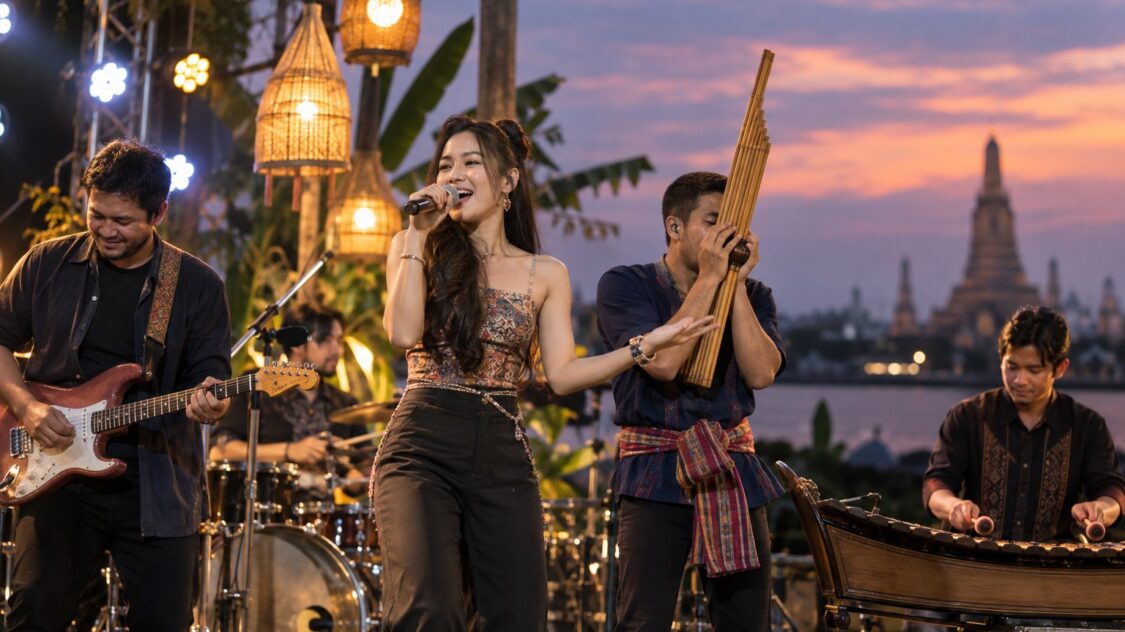
Open YouTube’s Thai music recommendations and you’ll bounce between entirely different worlds within minutes: a tightly choreographed pop group, then a singer describing life far from home, then a rapid-fire Isaan vocal style riding a dance beat. All three are Thai music, but the genre labels attached to them are telling different kinds of stories.
Some Thai music genres describe a sound. Others point to a region, a historical moment, or a lyrical outlook. Many overlap — a single song can have a luk thung singer, a mor lam rhythm, and production built for a modern pop audience.
This guide breaks down major genres of Thai music, with a song to start with for each one. Listen for the voice, the instruments, the rhythm, and the language. Those details usually tell you more than the label does.
If you’d rather begin with a mix of songs before learning the labels, this beginner’s guide to discovering Thai music offers a playlist and listening route through several of the styles discussed here.
T-Pop: Contemporary Thai Pop
T-Pop — short for Thai pop — is a broad name for contemporary popular music from Thailand. It is often associated with polished solo artists and groups, catchy hooks, high-production music videos, choreography, and active fan communities. The music itself can draw from R&B, electronic dance music, hip-hop, or ballads.
The visual side is especially noticeable with groups. A new song may arrive with a video, dance performance, live stages, and clips made for fans to share. That can make T-Pop a welcoming entry point for someone who doesn’t speak Thai yet: the performance gives you a sense of the song’s personality before you’ve understood a line of the lyrics.
4EVE’s “วัดปะหล่ะ? (TEST ME)” is a strong place to start. Its playful delivery, group choreography, and memorable refrain show why visual performance can be as much a part of the T-Pop experience as the recording itself.
Listen to how the members’ different voices keep the verses moving before the group comes together around the hook. A T-Pop song might have a rap passage, a softer vocal section, and a dance-oriented chorus within a few minutes. Those shifts are part of the appeal.
One distinction is useful: “Thai pop” can describe accessible popular songs from many decades, while “T-Pop” often brings to mind the current generation of artists and fan culture. The line between the terms is blurry. Not every Thai pop singer is an idol performer, and not every song called T-Pop is built for dancing.
Luk Thung: What Is Luk Thung Music?
Luk thung (ลูกทุ่ง) is usually translated as “Thai country music.” That’s a useful shorthand, but it can overstate the resemblance to American country. Luk thung developed its own vocal styles, storytelling traditions, and relationship to Thai rural life. Its songs have long addressed homesickness, work, love, and the experience of leaving home to earn a living elsewhere. Thailand Foundation’s introduction to luk thung explains how the genre combines Thai folk influences with contemporary musical elements.
The words ลูกทุ่ง mean “child of the fields,” but a luk thung song doesn’t have to take place in a field. The person singing may be in Bangkok, thinking about the village they left behind. That distance between where you are and where you feel you belong gives many songs their emotional pull.
The genre spans a wide range. An older recording and a recent stage production can sound almost unrelated, even when both are labeled luk thung. Regional accents, folk influences, and instruments vary too. A singer from the Northeast may bring Isaan language and mor lam influences into a song, while another recording may draw more strongly from Central Thai traditions.
A good entry point is ไผ่ พงศธร (Phai Phongsathon)’s “คนบ้านเดียวกัน” — “People from the Same Hometown.” It challenges the assumption that luk thung is only about romance. The song’s warmth comes from shared background and mutual understanding.
The title’s idea is simple: people who come from the same place can recognize something of each other’s lives. Listen to the way the vocal line carries that feeling. Luk thung singers often stretch, bend, or ornament a phrase to give a familiar sentiment a character of its own.
It’s also worth watching a live performance after hearing a studio recording. Luk thung can be a large, colorful stage experience, with dancers and an audience ready to answer the singer. The quieter story inside a song and the energy of its public performance belong to the same genre.
Mor Lam: The Sound & Performance Tradition of Isaan
Mor lam (หมอลำ) comes from the Lao and Isaan cultural world of Thailand’s Northeast. The word can refer to a performer as well as the performance tradition itself. Its roots lie in expressive vocal storytelling, historically accompanied by the khaen, a bamboo mouth organ. From there it has branched into forms ranging from intimate performances to large stage shows with dancers and amplified bands.
The distinction from luk thung is easier to grasp if you begin with their histories. Luk thung developed as a popular-song genre with strong rural associations and a national audience. Mor lam grew from a regional performance tradition in which the voice, its delivery, and its relationship with the accompanying music are central. Their paths meet so often that a clean divide between today’s recordings isn’t always possible.
That range is why “mor lam” doesn’t name one fixed tempo or set of instruments. You might hear a voice and khaen, or a fast, fully produced track built to move a crowd. The vocal delivery can feel more agile and rhythmically insistent than someone expecting a conventional pop melody might anticipate. Don’t assume, though, that every song by a mor lam artist will display every feature of an older performance.
จินตหรา พูนลาภ (Jintara Poonlarp)’s “เต่างอย” — named for Tao Ngoi, a district in Sakon Nakhon province — is an entry point into the tradition’s contemporary, dance-oriented side.
Here, follow the momentum of Jintara’s delivery and the way the song invites a physical response. Then, if you’re curious about the tradition behind that modern sound, look for a performance with a smaller group and a clearly audible khaen. Hearing the two in succession says more about mor lam’s range than treating either one as its definitive sound.
Tao Ngoi is in Sakon Nakhon, a province whose landscapes and everyday life also inspired Ajarn David’s song “Rak Sakon Nakhon,” which the artist discusses in the article: How I wrote “Rak Sakon Nakhon,” a Thai song for the road home.
Mor lam is a living tradition, rather than a fixed sound from the past. A modern beat doesn’t erase the regional language, vocal style, and performance history behind a song.
Luk Krung: Thailand’s Classic Urban Pop Song
Where luk thung is associated with the countryside, luk krung (ลูกกรุง) is associated with an older urban popular-song tradition. Recordings associated with luk krung were prominent in the middle of the twentieth century. They often feature carefully shaped melodies, formal diction, romantic lyrics, and controlled vocal delivery. The rural–urban comparison is helpful as long as it doesn’t reduce either genre to a stereotype.
The contrast comes through in the language. A luk thung singer may sound conversational, even when the lyric is poetic. A luk krung singer may give each word a more formal shape. That doesn’t make one genre more emotional than the other; they ask the voice to express emotion in different ways.
ชรินทร์ นันทนาคร (Charin Nantanakhon)’s “เรือนแพ” — “Houseboat” — is a clear example. Notice how much room the melody leaves the singer to shape each phrase. The effect is quite different from a contemporary pop song built around a short, repeated hook.
Try listening once without following the words. The measured pace lets the melody and vocal control hold your attention. Then return to the lyric and notice how closely the singer’s phrasing follows its images and sentiment. It’s a style that rewards paying attention to the whole line, rather than waiting for the chorus.
Luk krung also helps put T-Pop in perspective. Thai artists were making popular songs that brought different musical influences together long before anyone used the name T-Pop. The recordings may sound far apart, but both belong to the changing history of Thai popular music.
Phleng Phuea Chiwit: Thailand’s “Songs for Life”
Phleng phuea chiwit (เพลงเพื่อชีวิต) translates as “songs for life.” The name points as much to the music’s outlook as to its sound. The tradition became closely associated with Thailand’s student and democracy movements of the 1970s. Its songs have addressed ordinary people’s lives, inequality, work, politics, and social change, with arrangements ranging from acoustic folk to full-band rock. Thailand Foundation’s overview of songs for life provides more of that background.
That history might make the genre sound as though every track is a protest song. Some are openly political; others are concerned with the pressures and dignity of everyday life. A songwriter might focus on a worker, a family, a journey, or a frustration many listeners recognize. The subject can be personal while the song asks you to think beyond one person’s experience.
Carabao shows how direct and catchy a song for life can be. Their 1984 song “Made in Thailand” has the drive of a rock track and a chorus a crowd can sing together, while its subject — Thai-made goods and attitudes toward them — reaches beyond an individual love story.
Listen to the contrast between the song’s approachable, almost celebratory energy and the point it is making. That combination helps explain how music with a social message can become something people sing at a concert, rather than something they encounter only as political commentary.
A useful listening question here is: what is the song asking its audience to think about together? That often reveals more about phleng phuea chiwit than a list of instruments would. The tradition overlaps heavily with Thai folk and rock, so a song may sit comfortably under more than one heading.
Thai Rock: From Guitar Bands to Arena Choruses
Thai rock covers a lot of ground: alternative bands, heavier guitar music, emotional ballads, and songs written for large crowds to sing back at the stage. A Thai rock track can sound accessible enough for mainstream pop radio while still being driven by a band.
LABANOON’s “แพ้ทาง” captures the melodic side of Thai rock. Guitar, drums, and a big chorus give it a clear band identity, while the direct romantic lyric helps explain why listeners keep returning to it.
Notice that the instruments don’t have to be especially heavy to give the song its rock character. The band builds around the vocal, then opens the sound up for the chorus. If you come to Thai rock expecting only distortion and speed, you’ll miss how much of it depends on melody and a strong singalong moment.
Thai rock also illustrates why these genres rarely stay in separate boxes. A band can release a gentle pop ballad and a forceful rock anthem. It makes more sense to follow the musicians and songs than to expect every track to obey one formula.
Thai Hip-Hop: Language at the Center
Thai hip-hop gives artists room to play with rhythm, slang, accent, and rapid shifts in tone. Some tracks are playful; others are personal or socially pointed. The style can make striking use of Thailand’s linguistic variety, with regional speech and English mixed in alongside standard Thai.
Rapper MILLI brought international attention to Thai hip-hop when she performed at Coachella in 2022. Her performance included “Mango Sticky Rice” and ended with her eating the dessert on stage. Her earlier track “พักก่อน” offers a more useful starting point for hearing her flow: even without following every line, you can hear the shifts in rhythm and attitude. Thailand Foundation’s overview of Thai rap and hip-hop has more background on the scene.
Listen for how she changes pace and emphasis, and how those changes give the track its personality. The beat matters, but so does the decision to hurry through one thought and linger over another. In hip-hop, pronunciation and timing become part of the composition.
For anyone learning Thai, rap can be demanding. The words arrive quickly and often depart from textbook language. It’s also one of the liveliest ways to hear artists use speech as part of their musical identity.
Thai Indie: An Approach That Crosses Genres
“Indie” can describe an artist’s position outside the biggest label systems, but listeners also use it loosely for certain sounds and sensibilities. That makes it less precise as a genre label than luk thung or mor lam. A Thai indie artist might make guitar pop, electronic music, R&B, or something difficult to categorize.
The label becomes more useful when you treat it as a way of finding artists rather than a test they must pass. A small band can gather an audience online, reach a festival stage, and eventually work with a label. People may continue calling its music indie because of the songs they associate with the band, regardless of what changed behind the scenes.
THE TOYS’ “ลาลาลอย (100%)” demonstrates some of that freedom. Its vocal phrasing and production don’t ask to be heard as a conventional ballad or a standard guitar-band track.
When “Thai indie” appears on a playlist, treat it as an invitation to explore rather than a promise that everything will sound alike. For a longer listen across different sounds and artists, see this Thai indie music playlist of songs and artists to know in 2026.
If you’d rather discover artists on stage, Thailand’s festival calendar includes events focused on local bands alongside much larger pop and electronic festivals. The Thailand music festival guide for late 2026 and early 2027 compares the events and the practical details of attending them.
Thai Traditional Music: A Different Way to Listen
The genres above are only part of Thailand’s musical landscape. Thai traditional music includes instrumental and vocal forms performed in ensembles such as piphat, khrueang sai, and mahori. Their instruments, settings, and musical structure differ from those of a pop band. Chulalongkorn University’s account of a piphat performance tradition shows how this music continues to be performed and preserved.
These ensemble names describe different combinations of instruments rather than different versions of a pop genre. Piphat is strongly associated with wind and percussion instruments. Khrueang sai places string instruments at its center, while mahori brings together instruments from different families. If all three initially sound unfamiliar, watch the musicians as well as listening: seeing which instrument carries a phrase can make the texture easier to follow.
“ลาวดวงเดือน,” heard here in a piphat mai nuam arrangement, is a good first listen. Follow the melody as it passes between instruments rather than waiting for a verse-and-chorus structure.
On a second listen, pay attention to what happens around the melody: the small rhythmic cues, the overlapping instrumental lines, and the sense that the players are moving through the piece together. It asks for a different kind of attention from a pop recording, but you don’t need to know the name of every instrument before you can enjoy it.
Regional folk traditions deserve attention alongside the better-known national genres. Northern, Southern, Central, and Northeastern traditions have their own instruments and performance practices. “Traditional Thai music” is a starting label, not a description of one uniform sound.
Where the Genres Meet
Once you’ve heard a few examples, the overlap becomes easier to spot. Luk thung artists use pop production. Mor lam performers share stages with rappers. A songs-for-life band can sound like rock. A T-Pop release might borrow a regional rhythm or a phrase of Isaan speech. None of these combinations needs a new label to be understood.
Duets can make those crossings especially easy to hear. Bird Thongchai and Jintara Poonlarp’s “มาทำไม,” for example, brings a pop singer and a voice associated with luk thung and mor lam into a playful exchange. It’s one of the songs discussed in this playlist of Thai duets for karaoke.
Language is a useful clue when you’re trying to place a song. Standard Thai, Isaan speech, English, and other regional forms can change how a track feels and whom it addresses. So can the world implied by the lyrics: a journey back home, a night out, a private heartbreak, or a crowd singing together.
Mood offers another route through the genres. If you want to follow the sound of heartbreak across pop-rock, acoustic ballads, and older favorites, this playlist of sad Thai songs for the heartbroken brings those styles together.
Frequently Asked Thai Music Questions
What is T-Pop?
T-Pop refers to contemporary Thai pop music. The term is often associated with polished artists and groups, high-production videos, choreography, and active fan communities, though the music itself covers a wide range of styles.
What’s the difference between luk thung and mor lam?
Luk thung is often called Thai country music and has a strong tradition of songs about love, work, rural life, and home. Mor lam is an Isaan and Lao vocal and performance tradition historically associated with the khaen. The two frequently overlap.
What does luk krung mean?
Luk krung means “child of the city.” It refers to an older Thai urban popular-song tradition associated with carefully shaped melodies, formal diction, and controlled vocal delivery.
What is phleng phuea chiwit?
Phleng phuea chiwit means “songs for life.” It is a Thai musical tradition closely associated with socially conscious lyrics and the political movements of the 1970s. Its sound can range from acoustic folk to rock.
Is Thai hip-hop heard outside Thailand?
Yes. MILLI’s 2022 Coachella performance brought international attention to a Thai rapper, while Thai hip-hop artists continue to reach listeners through online music and video platforms.
The simplest way into Thai music is to start with the recording that catches your ear, then follow it. If you like a vocal style, follow the singer; if you like a rhythm, look for related performances in that tradition. If you want to join in yourself, these easy Thai songs to sing and learn for karaoke offer another starting point. Each route leads to a different part of Thailand’s music — and often loops back across the genre boundaries you thought you’d just learned.

- Thai Music Genres Explained: T-Pop, Luk Thung, Mor Lam and More - September 16, 2026
- Thailand Music Festival Guide: Late 2026–Early 2027 - September 14, 2026
- Discover Thai Music: A Beginner’s Guide and Song Playlist - September 9, 2026