Discover Thai Music: A Beginner’s Guide and Song Playlist
When 16-year-old Thai guitarist Nene Royal walked onto the America’s Got Talent stage in the summer of 2026, she gave millions of viewers outside Thailand a glimpse of something Thailand already knew: the country produces musicians of extraordinary skill and stage presence.
Nene — whose real name is Rattikarn Amloy — had already built a following of several million people online before her audition, largely on the strength of viral covers of Nirvana and System of a Down.
On AGT, she opened with a two-hand-tapping version of The Cranberries’ “Zombie” that earned four yeses and racked up millions of views within a day. She followed it with Muse’s “Hysteria” in the Judges’ Callbacks, then a searing cover of Soundgarden’s “Black Hole Sun” in the live quarterfinals — a performance that moved judge Mel B to hit the Golden Buzzer and send her straight to the final, scheduled for September 22–23, 2026.
Her run has done what these moments usually do: it’s sent people outside Thailand looking for more. What else is happening in Thai music?
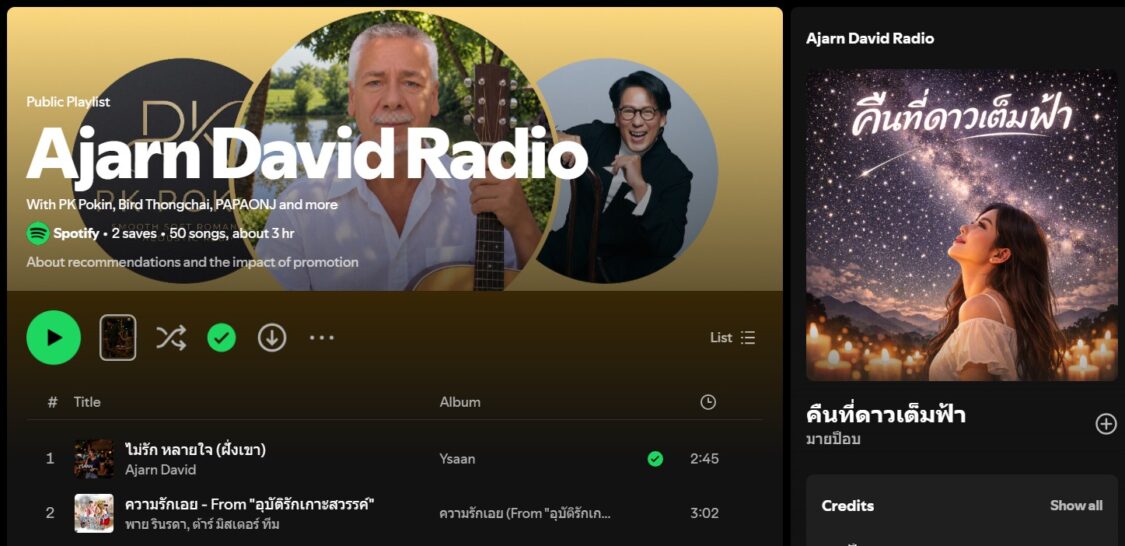
One good answer can be found on Spotify’s playlist Ajarn David Radio — a 50-song, roughly three-hour-and-fifteen-minute mix generated around the new songs of bilingual poet and songwriter Ajarn David, who has lived in Thailand for over 20 years.
It’s not a curated history of Thai pop. It’s something more useful for a newcomer: a long, well-sequenced on-ramp, mixing Ajarn David’s own English-Thai recordings with major Thai stars, veteran rock bands, soundtrack hits, acoustic duos, and regional artists.
Thai music is bigger than most outsiders assume
People coming to Thai music for the first time often expect one recognizable sound. What they find instead is a decades-long conversation between genres.
Western pop and rock have long been absorbed into Thai songwriting rather than simply copied — reshaped by tonal language, expressive vocal delivery and a real gift for melodrama done well.
Alongside mainstream Thai pop (called “string” locally) sit luk thung (Thai country music), regional styles tied to the Isaan and Northern provinces, and phleng phuea chiwit — “songs for life,” a folk-rock tradition that became closely associated with Thailand’s student and democracy movements of the 1970s, as well as social commentary and working-class experience.
Ajarn David’s Thai song playlist touches all of it: polished ballads next to distorted guitars, understated acoustic tracks next to soundtrack drama, without ever needing the listener to know the genre boundaries in advance. The transitions teach you as you go.
Start with Bird Thongchai, Thailand’s defining pop superstar
No entry point into modern Thai pop skips Bird Thongchai McIntyre. Born Albert Thongchai McIntyre in 1958, Bird debuted in 1986, has sold more than 25 million albums and was named a National Artist of Thailand in 2023. He is, by most measures, the country’s best-selling solo act ever.
The Thai music playlist samples several sides of him: “รักเอ๋ย” (roughly “Oh, Love”), from the drama Phanom Naga, treats devotion as something that survives time and distance; “คนแพ้ที่ไม่มีน้ำตา” (“The Loser With No Tears”) plays apparent strength as a cover for private grief; “เล่าสู่กันฟัง” (“Tell Me About It”) shows his warmer, conversational pop side.
What holds all of it together is that his songs are immediately accessible without ever sounding lazy — the melodies do real work.
The Thai rock lineage: Loso, Cocktail, Klear, TaitosmitH
Given how Nene got noticed, listeners arriving via AGT may want to go straight to Thai rock, and the playlist gives several strong routes in.
Loso, led by singer-guitarist Sek Loso (Seksan Sukpimai), is the band most responsible for the sound. Their name is a deliberate pun on “hi-so” — Thai slang borrowed from “high society” — flipped to signal the band’s working-class roots; Sek grew up in a rice-farming family and bought his first guitar with money saved from factory work.
Loso became one of the few Thai acts to play internationally, including SXSW and Glastonbury. “แทบขาดใจ” (“Almost Brokenhearted”) and “ลาจากเธอ” (“Leaving You”) show how naturally their version of rock pairs big guitar hooks with romantic vulnerability.
Cocktail‘s “ลั่นทม,” written for the drama I Feel You Linger in the Air, leans more cinematic — a song built to carry the story’s theme of love enduring across time.
Klear‘s “แพ้ใจ” brings a cleaner, more modern rock-pop sound to the same territory: the moment you stop being able to control your own feelings.
TaitosmitH, formed in 2018, moves the playlist toward contemporary phleng phuea chiwit — they call themselves exactly that, a modern songs-for-life band, and NME named their self-titled record among its best Asian albums of 2020.
Their track “ว่าไงคนเก่ง” is a quiet pep talk to someone worn down by life, which matters here because it’s a reminder that Thai popular music isn’t only about romance — plenty of it is about solidarity and getting through the day.
Distinctive Thai Singers: Palmy, Da Endorphine, Praew Kanitkul
The women singers on Ajarn David Radio show how wide the range of Thai pop vocals actually is.
Palmy (born Eve Pancharoen), recording since her 2001 debut, moves comfortably between pop, R&B and pop-rock and has performed in Japan, South Korea, Singapore, Australia and the UK — genuinely rare territory for a Thai solo act. Her song “ความเจ็บปวด” (“The Pain”) is a controlled, unshowy breakup song; the power comes from restraint, not volume.
Da Endorphine, formerly the lead singer of the rock band Endorphine, brings a bigger, more theatrical delivery as a solo artist.
Praew Kanitkul shows up several times on the playlist, and it’s easy to hear why: her singing is conversational rather than operatic, which makes complicated situations — a partner who loves someone else, a request for dignity instead of an explanation — land as something closer to speech than performance.
Soundtracks as a gateway into Thai culture
A noticeable share of the Thai playlist comes from television dramas and films, and that’s worth explaining rather than glossing over. In Thailand, a strong drama theme song routinely outlives the show it was written for — it becomes a hit in its own right.
Tracks tied to Phanom Naga, I Feel You Linger in the Air, Klin Kasalong and other productions are built to carry a scene’s emotional weight, and following one back to its source drama is a reasonable way to stumble into Thai historical fiction, ghost stories, or rural romance — genres that shape a lot of what gets written about love in Thai pop music.
Thai Music Beyond Bangkok
The playlist doesn’t treat Bangkok as the whole story. Mhai Muang’s “เก็บไว้ให้ชื่นใจ” carries the relaxed, country-inflected warmth associated with Northern Thai duos — its lyric dismisses grand romantic gestures (a pressed flower, sand in a jar) in favor of just picking up the phone.
Pang Nakarin and luk thung singer Takkatan Cholada’s duet “ภูมิแพ้กรุงเทพ” (“Allergic to Bangkok”) turns urban-rural friction into a flirtatious argument — a Bangkok man claims his doctor sent him to the countryside for his health, and the provincial woman suspects his real allergy is other Bangkok women. It’s funny, it’s a strong karaoke pick, and it’s a much better introduction to regional Thai humor than any ballad could be.
Other selections prevent the mix from settling into a single sound or era. Terracotta’s “นักประดาน้ำ” (“The Diver”) brings an enduring alternative-pop favorite; Rose Sirintip’s bilingual-titled “A Tu Corazon สู่กลางใจเธอ” adds Latin phrasing to Thai pop; Byrd & Heart represent an earlier generation of melodic songwriting; and Doobadoo‘s light, bossa-inflected “โอ้ใจเอ๋ย” changes the playlist’s pace and texture.
Smoother pop-rock from Peacemaker and ETC. sits alongside the polished contemporary sound of Ink Waruntorn, giving newcomers several different directions to explore.
Thai love songs land before you know the words
Love, distance, jealousy and missing someone make up most of the Thai music playlist, which could read as narrow until you notice how many different angles Thai writers find inside those same four or five feelings.
Manutsavee‘s “คิดถึงเรื้อรัง” treats missing someone as a chronic condition rather than a moment. Bie Sukrit‘s “I Need Somebody” gives loneliness a hook simple enough to sing along to on first listen.
Thai vocal delivery helps here regardless of whether you speak the language: singers frequently hold a key word past where the sentence should have ended, letting the melody carry emotion the lyric has already finished stating.
A handful of recurring words go a long way — rak (love), kit teung (miss/think of), jai (heart), namta (tears) — and once you can pick those out, a lot of the songs open up faster than expected.
Bilingual Thai-English songs open the door to Thai music
Ajarn David Radio opens with “ไม่รัก หลายใจ (ฝั่งเขา),” the male perspective in a pair of songs that tells the story of a troubled relationship from both sides. The acoustic arrangement and alternating Thai-English lyrics introduce Ajarn David’s approach immediately: emotionally direct storytelling designed to be understood and sung across languages. To hear the female perspective, “ไม่รัก หลายใจ (ฝั่งเธอ),” listeners can continue to Ajarn David’s Ysaan EP, where both versions appear together.
The Thai song playlist also includes “ไม่รักแม่ค้า” (Mai Rak Mae Kha), in which a man insists he isn’t in love with the woman who sells him noodles—until her shop closes and he realizes how much he misses her. The setting is deliberately small: this isn’t romance staged somewhere abstract; it is built from a daily greeting, a familiar order and the sudden gap left when someone who was part of the routine disappears.
“คิดถึงเธอ” (Kit Teung Teu, “I Miss You”) and “รักสกลนคร” (Rak Sakon Nakhon) complete the selection of Ajarn David’s songs on the playlist. While the first explores romantic longing, “รักสกลนคร” is a Thai-English love song about Sakon Nakhon and the culture of northeastern Thailand. Built around specific places, food and shared experiences rather than generic scenery, it feels like affection for a real place instead of a postcard.
All four Thai love songs sit comfortably beside the established Thai hits because they share the same qualities: plain-spoken emotion, accessible arrangements and storytelling over spectacle.
What sets them apart is that they move deliberately between Thai and English.
These are not finished songs with translated lines added afterward. Ajarn David writes them so Thai listeners with limited English can sing the English sections, while international listeners with limited Thai can attempt the Thai. Both languages participate in the same performance rather than simply standing in for each other.
Practically, that solves a real problem for newcomers. Thai script can be difficult to approach without prior knowledge, while transliteration is inconsistent and rarely captures the language’s tones or natural rhythm. A bilingual chorus allows listeners to understand the situation first and then begin noticing how Thai phrases fit within the melody—closer to picking up a language than studying one.
Together, these songs make the Ysaan album a natural bilingual entry point into Thai music.
Why Ajarn David Radio is such a good place to explore Thai music
Several qualities make this Thai playlist unusually welcoming to an international audience:
- It combines recognition with discovery. Major figures such as Bird Thongchai, Palmy, Loso and Da Endorphine provide a foundation, while less internationally familiar singers and soundtrack performers invite further exploration.
- It crosses generations. The playlist doesn’t treat Thai music as if it began with the current international rise of T-pop. Long-established songs sit beside newer recordings, so listeners hear continuity as well as change.
- It balances genres without becoming random. Pop, rock, acoustic music, songs-for-life influences, country colors, bossa nova and soundtrack drama all appear, but strong melody and emotional storytelling hold the sequence together.
- It reveals the importance of lyrics. Many titles translate into direct emotional statements — “I Miss You,” “If You Are Going to Leave,” “The Pain,” “Tears,” “Change,” “I Need Somebody.” Their simplicity is an invitation to dig into the more nuanced stories underneath.
- It includes both urban and regional Thailand. Bangkok is here, but so are provincial settings, Northern musical warmth, Isaan identity and everyday local life.
- It provides a bilingual doorway. Ajarn David’s Thai-English songs give non-Thai listeners something they can follow immediately, while their ears adjust to the sound and rhythm of Thai.
- It encourages active discovery. Spotify radio is generated from musical relationships, so any one track can lead somewhere else — an artist’s full catalogue, a drama soundtrack, a genre playlist, or a Thai phrase worth learning.
Nene Royal’s run on AGT matters for more than one talented teenager — it’s a reminder that Thai artists aren’t a regional footnote. Where her performances land instantly for any rock listener, this playlist takes the longer route: familiar pop and rock names leading into soundtrack drama, regional duets and bilingual songwriting. Don’t worry about understanding every word on the first pass. Follow whatever you recognize first — a guitar line, a chorus, a voice — and let the rest come from there.
Listen to Ajarn David Radio on Spotify, save the Thai songs that stay with you and follow their artists into the wider world of Thai music.

- Thai Music Genres Explained: T-Pop, Luk Thung, Mor Lam and More - September 16, 2026
- Thailand Music Festival Guide: Late 2026–Early 2027 - September 14, 2026
- Discover Thai Music: A Beginner’s Guide and Song Playlist - September 9, 2026