Thai Love Song with Bilingual English-Thai Lyrics

Ajarn David’s “Kit Teung Teu” is something that doesn’t come along very often: a genuinely bilingual Thai love song built to reach Thai listeners and international audiences at the same time — and to make both feel like it was written for them.
There are Thai love songs that wash over you, and there are Thai love songs that stop you. “Kit Teung Teu” — the title means something close to “I’m thinking of you” or “I’m missing you” — aims to be the second kind.
Written and produced by Ajarn David, an American-born university lecturer who has made Thailand his home since 2002, the song is not a novelty project or a cultural experiment. It is a modern Thai love song that grows naturally out of work he has been doing for years: finding ways to carry Thai language and emotional life into the English-speaking world, and to bring English speakers a little closer to Thailand.
The structure is a male-female duet. The male voice sings in English. The female voice sings in English too, with a little Thai thrown in. The chorus belongs to both voices together, repeating the Thai phrase kit teung teu (คิดถึงเธอ) — “I’m thinking of you, or I’m missing you” — until it does what great Thai love songs do: it stops being words and becomes a feeling you carry out of the room with you.
For international viewers, the current music video includes English subtitles for the English verses. The Thai chorus is rendered in Roman-alphabet transliteration, as is a Thai phrase used in Verse 2, so non-Thai speakers can follow the sound of the language in real time.
The result is a bilingual Thai love song with English subtitles that works as both entertainment and a small, painless introduction to the Thai language — you can sing along with the chorus by your second listen without knowing a single Thai character.
The Man Behind the Love Song
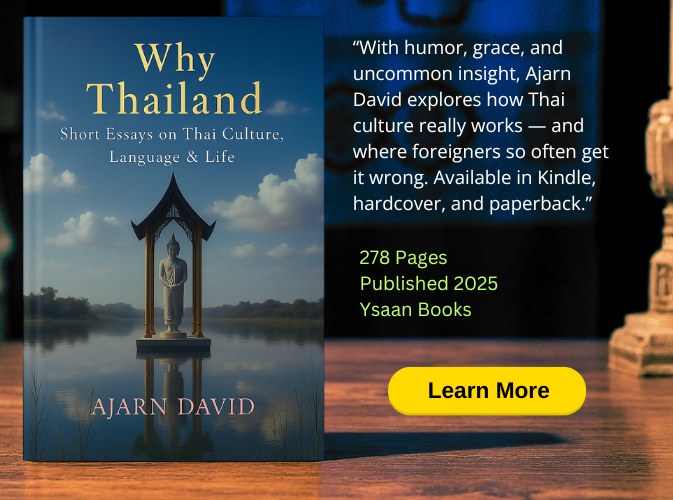
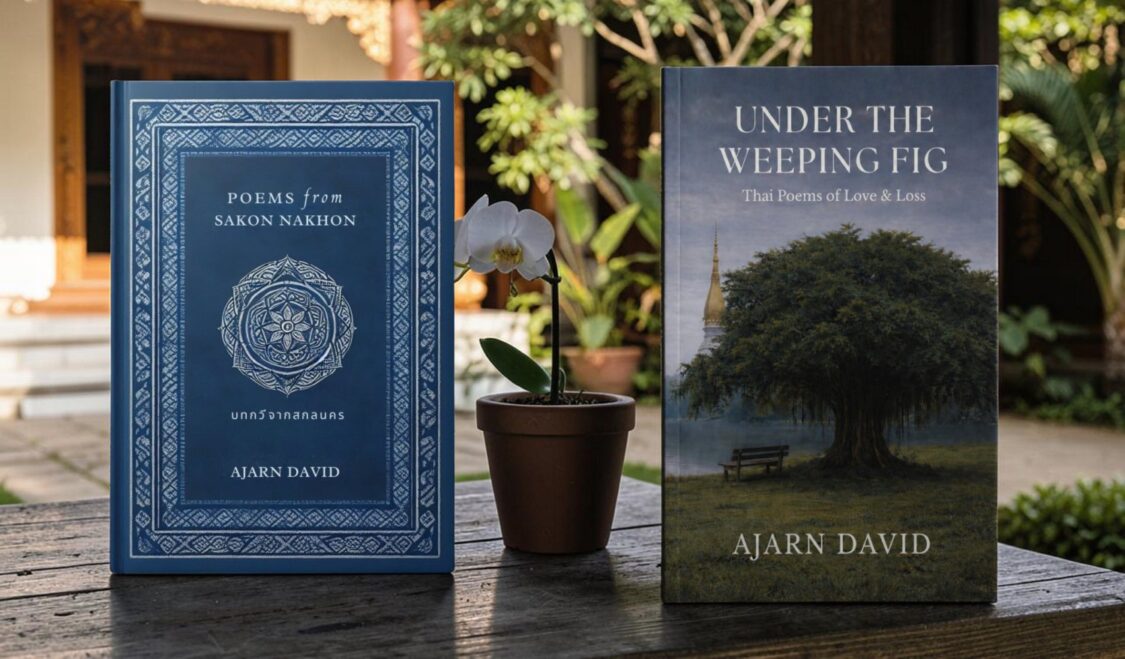
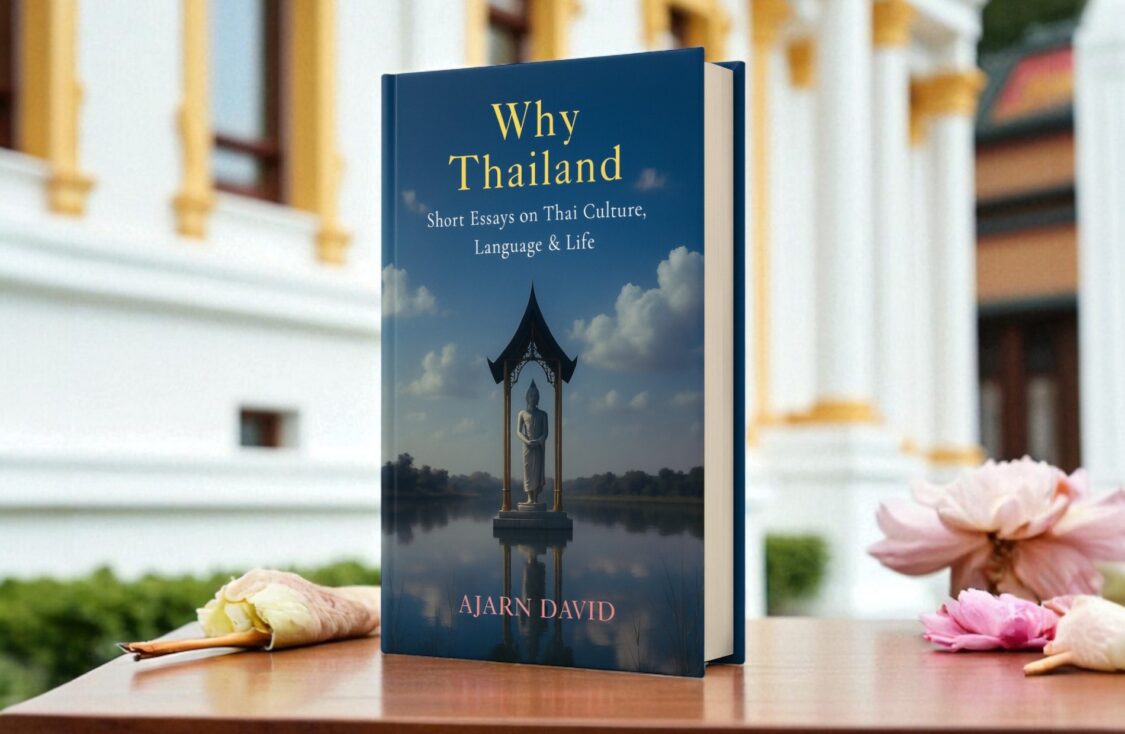
Ajarn David arrived in Thailand in 2002 and has spent more than two decades teaching English at Thai universities, most recently at Sakon Nakhon Rajabhat University in the Isaan region of northeastern Thailand, where he lives on a farm with his Thai wife and daughters. In that time he has written a collection of essays on Thai culture called Why Thailand, and two bilingual poetry books — Poems from Sakon Nakhon (2025) and Under the Weeping Fig (2026) — both published by Ysaan Books.
The poetry books are where his reputation as a cultural bridge-builder has solidified. In Poems from Sakon Nakhon, each poem appears in both English and Thai with full phonetic transliteration, so that learners can hear the language even on the page.
In Under the Weeping Fig, the approach changed. Rather than writing the English poems first and translating them into Thai afterward, he began writing both versions simultaneously — his mind switching back and forth between languages as he worked. He is clear in the book’s introduction that the result is not translation. It is parallel expression: two versions of the same experience, each shaped by what its own language can and cannot do.
“Kit Teung Teu” carries that same idea into song. The two verses do not simply say the same things in different languages. Each voice has its own personality, its own emotional approach, its own way of getting lost. The shared chorus is where they finally meet.
He has also been a consistent advocate for Thai free verse — a form he notes is still finding its footing in Thailand — and has expressed hope that his bilingual work will push Thai poets toward Thai-English collections that can reach wider audiences.
“Kit Teung Teu” extends that push into popular music. A bilingual poem can move a reader who is curious about Thailand. A bilingual Thai love song can reach people who might never pick up a poetry collection.
The Lyrics: What Is Actually Going On in This Thai Love Song
What makes “Kit Teung Teu” work as a Thai love song is not just the bilingual structure. It is the specific story the song tells, and how much that story depends on who is speaking which language.
Verse 1 (Male, English): The male voice opens by confessing awkwardness — he wants to tell her how he feels but can’t find the words, partly because she handles English so effortlessly and he feels ridiculous by comparison.
It’s a charming setup. The irony writes itself: he is singing this confession in fluent (albeit simple), well-rhymed English, which tells you something about the gap between how people feel inside and how they actually come across. He thinks he sounds like a fool. He does not sound like a fool.
The Chorus (Duet): Both voices together: kit teung teu, kit teung teu, kit teung teu / roo mai wa / kit teung teu. The transliteration for non-Thai speakers in the video reads: “I’m thinking of you, I’m thinking of you — do you know? — I’m thinking of you.”
All the awkwardness of the verses falls away here. There is no cultural negotiation in the chorus, no language barrier, no misread signals. Just two people saying the same thing in Thai together. Roo mai wa — “do you know?” — is the emotional hinge of the whole song. Missing someone quietly is one thing. Wondering if they know you’re missing them is another thing entirely.
Verse 2 (Female): She opens with Oh, Phrajao loei — a Thai exclamation that lands somewhere between “Oh my God” and “Lord, give me strength” — and you understand her character immediately.
She is exasperated. She is not cruel, just direct in the way that many Thai women are often direct: she would like men to say what they want clearly instead of making her read their minds. In the video the phrase Phrajao loei is transliterated for international viewers who don’t speak Thai but can still recognize exasperation in any language.
Verse 3 (Male, English): The emotional register shifts. He waited for her. She didn’t come. He is sitting alone wondering what he means to her. This is recognizable territory — the specific loneliness of caring more than you can confirm the other person does. He is no longer just awkward; he is genuinely hurt.
Verse 4 (Female, English): This is where the Thai love song becomes more interesting emotionally. She points out the fact he is speaking in English, the very language he said made him feel foolish.
She picks up his own contradiction and holds it up: look at you now with all your English. But then something shifts. If only you knew how I really feel / Then you’d know it’s hard for me too.
She has not been dismissive. She has been afraid. Both of them have been circling the same feeling, failing to get there for the same reason. The language barrier was never really about language.
The song ends on the chorus again, unresolved. Both voices still asking roo mai wa — still hoping the other one knows. No answer is given. It is the kind of ending many Thai love songs are comfortable with: emotionally open, unresolved, and still longing.
@ysaanbooks คิดถึงเธอ Thai Love Song in English ฟังเพลงไทยเพลงแรกของอาจารย์เดวิด “คิดถึงเธอ” เพลงสองภาษาเหมือนบทกวีของเขา ร้องทั้งไทยและอังกฤษ ฝากฟังแล้วบอกความรู้สึกกันด้วยนะ Listen to Ajarn David’s first Thai song, “Kit Teung Teu.” Like his poetry, the song blends both Thai and English. Have a listen and let us know what you think! #เพลงเพราะ #เพลงรัก ♬ original sound – บทเรียนรัก
What the Poetry Has to Do with This Thai Love Song
If you have read Ajarn David’s poetry collections before listening to “Kit Teung Teu,” the song’s emotional territory will feel familiar immediately.
Both books are full of people who cannot quite say what they mean to the person who matters. In Under the Weeping Fig, one Thai love poem deals directly with this problem: the speaker wants to say “I miss you” in English but finds it falls flat, somehow too thin to carry the actual feeling. He says it in Thai instead — kit teung teu — and that version gets there. The song dramatizes this same situation, not as a philosophical argument but as a lived experience between two specific people.
The poetry also circles around waiting — the particular kind of waiting that passes itself off as contentment but is actually hope. One poem describes a man who keeps a love alive through proximity alone, engineering moments on sidewalks and staircases and in old noodle shops for the chance of an encounter, once a week if he’s lucky.
He never speaks. The love is completely interior. The male voice in “Kit Teung Teu” is a related figure — a man who waited an entire evening, she didn’t come, and now he’s sitting alone with that specific feeling.
Then there is the self-doubt thread. Ajarn David’s poetry keeps returning to people who are convinced the image someone has of them cannot be accurate. One Thai poem imagines a woman who genuinely cannot recognize herself in how a man looks at her — whatever he’s seeing, she is certain it isn’t her.
Another gives us the “hopeless romantic” pulled between a small voice saying go for it and the louder one that follows: you idiot, you went too far. The male voice in this Thai love song lives in that emotional neighborhood. He knows what he feels. Getting it expressed is the problem.
The language argument runs through everything Ajarn David has written. In Poems from Sakon Nakhon, one poem argues plainly that French is not the language of love — Thai is. Not the flashy, surface kind, but a deeper, more protective love that gives without asking anything back.
In Under the Weeping Fig, another poem compares the English “unrequited love” to its Thai equivalent ruk kahng dio — one-sided love — and finds the Thai version more honest about what love actually does. Language, in this body of work, is never neutral. It shapes the feeling it carries.
The song itself never tries to lecture the listener about any of this. It simply lets the emotional and linguistic tension play out naturally between two people.
Where This Thai Love Song Sits in Thai Popular Music
Thai popular music has always been comfortable sitting inside longing. Thai love songs often treat missing someone not as a problem to solve but as an emotional state worth inhabiting fully. “Kit Teung Teu” fits into this tradition naturally, particularly because of what it doesn’t do: it doesn’t resolve. The chorus asks roo mai wa — do you know? — and the song ends with the question still open.
The male-female duet format has a rich history in Thai pop. From the emotional ballad pairings of the 1980s and 90s onward, Thai listeners became deeply familiar with songs where each voice carries only part of the emotional picture, and meaning emerges from hearing both perspectives together. Bird Thongchai and Jintara Poonlarp’s “Ma Thammai” became one of the defining examples of this crossover emotional style, blending male and female viewpoints into a single conversation. Many Thai duets build their power from this asymmetry — the man hearing one story, the woman another, and the listener holding both at once.
“Kit Teung Teu” inherits this structure and does something new with it: the two voices don’t just have different emotional perspectives, they start in different languages. When they finally meet in the chorus, you feel the distance that has been crossed.
Thai-English pop crossover is not completely new — Palmy wove English and Thai together, Slot Machine experimented with bilingual and international releases, and Milli brought Thai pop-rap to global attention. But in most mainstream crossover songs, Thai still remained the emotional center, with English used more as texture, emphasis, or expansion rather than the primary emotional language.
There is also a social observation embedded in the song’s structure that Thai listeners will probably recognize immediately. In Thailand, English fluency carries social weight — it signals education, cosmopolitanism, ambition.
The female character in the song seems comfortable with it; the male character is intimidated. This is a dynamic that plays out in relationships, classrooms, and workplaces across Thailand. The song uses it to illuminate a very specific kind of romantic anxiety: not just does she like me but am I enough for someone like her.
The bilingual frame makes visible an insecurity that a single-language Thai love song would have to explain much more directly.
A Thai Love Song That Teaches Without Trying To
One of the quieter things “Kit Teung Teu” pulls off is that it works as Thai language education for international audiences without feeling remotely like a class.
The music video includes English subtitles for the English verses, which is expected. What is less expected is the transliteration: the Thai chorus is written out in Roman script, and so is the Thai exclamation Phrajao loei that opens Verse 2.
A viewer who has never heard spoken Thai before can follow the whole song phonetically on a first watch, without needing to know a single Thai character. They hear Kit Teung Teu repeated through the chorus, see it written phonetically, connect it to a feeling they recognize — missing someone — and walk away with a small piece of the language.
One of the biggest obstacles to Thai language interest among international audiences is the sheer visual unfamiliarity of Thai script, combined with the real difficulty of Thai tones for ears trained on European languages.
Most Thai songs that reach international listeners arrive without phonetic support. This bilingual Thai love song sidesteps that problem naturally, without flattening the language or making it feel artificially simplified.
Ajarn David has spent more than twenty years teaching English to Thai students, and in recent years about Thai for English-speaking audiences — through his cultural essays, and bilingual poetry collections. “Kit Teung Teu” feels like a continuation of that same long-running project. It just happens to arrive in the form of a pop song.
Thai Culture, Going Somewhere
“Kit Teung Teu” arrives at a moment when Thai culture is genuinely moving outward. Thai cuisine has been internationally embedded for decades. Thai cinema has found real audiences abroad — not just festival circuits but streaming platforms where horror films, action movies, and art films from Thailand are being discovered by people who would never have found them otherwise.
Thai literature has been slower to travel, though that is changing. And Thai pop music, long almost entirely domestic, is beginning to find international listeners through the same platforms.
What has been hardest to carry across is Thai as a living language — the particular sound of it, the emotional texture of it, the way it handles love and loss and longing differently from European languages.
That is the gap Ajarn David’s work has been trying to close for years. His poetry makes the case that Thai and English can coexist in a single work without either language becoming subordinate. This Thai love song makes the same case in a format that reaches far more people.
It is worth remembering that this is not a foreigner performing Thai culture at arm’s length. Ajarn David has lived in Thailand for more than twenty years. He has raised daughters in Thai culture, taught at Thai universities in provincial cities, and built a life in Isaan that has nothing to do with the tourist trail. His advocacy for Thai language and culture is not promotional; it comes from lived experience inside the culture itself.
A Few Other Things Worth Noticing About This Thai Love Song
The song works differently depending on who is hearing it. For Thai listeners, something unusual is happening: English appears in the song as the awkward, aspirational language — the one the male character fumbles in, the one he is self-conscious about — while Thai is the shared language of genuine feeling. In a country where English fluency carries a lot of social weight, this is a subtle reversal. The chorus is not in English. The most emotionally direct statement in the song is in Thai.
For international listeners, the experience is almost the opposite. The English verses are where they feel at home; the Thai chorus is the place they’re being invited to reach toward. The song manages both experiences at once without forcing either audience to feel excluded.
The unresolved ending is also worth sitting with. The song does not give you a resolution. Both voices are still asking roo mai wa when it finishes — do you know? The answer never arrives.
Thai love songs have a long tradition of leaving listeners inside the longing rather than releasing them from it, and “Kit Teung Teu” stays faithful to that tradition while giving it a bilingual shape that feels unusually modern.
“Kit Teung Teu” is a Thai love song that does not need you to speak Thai to feel it. But it might make you want to start.