Can Free Verse Be True Thai Poetry?
The Beauty of Classical Thai Poetry
Classical Thai poetry is not a set of rules. It is one of the most elaborate and internally coherent literary systems any civilization has devised — one in which sound, tone, meaning, and structure are woven so tightly together that to pull at any thread is to alter the entire fabric. Any discussion of free verse in Thailand that skips this fact is not taking the question seriously.
The four principal classical forms — กลอน (glon), กาพย์ (kap), โคลง (khlong), and ฉันท์ (chan) — impose requirements that most Western poetic traditions have never attempted simultaneously. กลอน, the form most familiar to modern Thai readers, governs not only the number of syllables per line but the tonal patterns of specific syllables, the rhyme schemes between lines, and the internal acoustics of each wak, each rhythmic unit. โคลง further requires that certain syllables fall on prescribed tones as precisely as a musical score. ฉันท์, drawn from Sanskrit prosody, adds quantitative syllable length. กาพย์ offers yet another set of formal arrangements, most often encountered in ceremonial and court contexts.
These constraints, accumulated over centuries through Thailand’s royal courts, temple scholarship, and oral performance, became a source of beauty in themselves. When a skilled poet achieves the right word in the right tonal position in โคลง, there is an artistic satisfaction — a click of rightness — that no other kind of writing quite replicates. The form does not merely shape what the poet can say; it shapes how meaning is experienced in the body of the reader.
It is reasonable, then, that Thai scholars and literary traditionalists feel unease when free verse gains cultural visibility alongside — or instead of — these poetic forms. The concern is not simple conservatism. Mastery of classical Thai poetry requires sustained institutional support, committed teachers, and an audience that values formal complexity. These things are not guaranteed. If free verse crowds out that commitment, something irreplaceable may quietly disappear.
The defenders of classical Thai poetic tradition are not wrong to love what they love, and they are right to insist it not be forgotten.
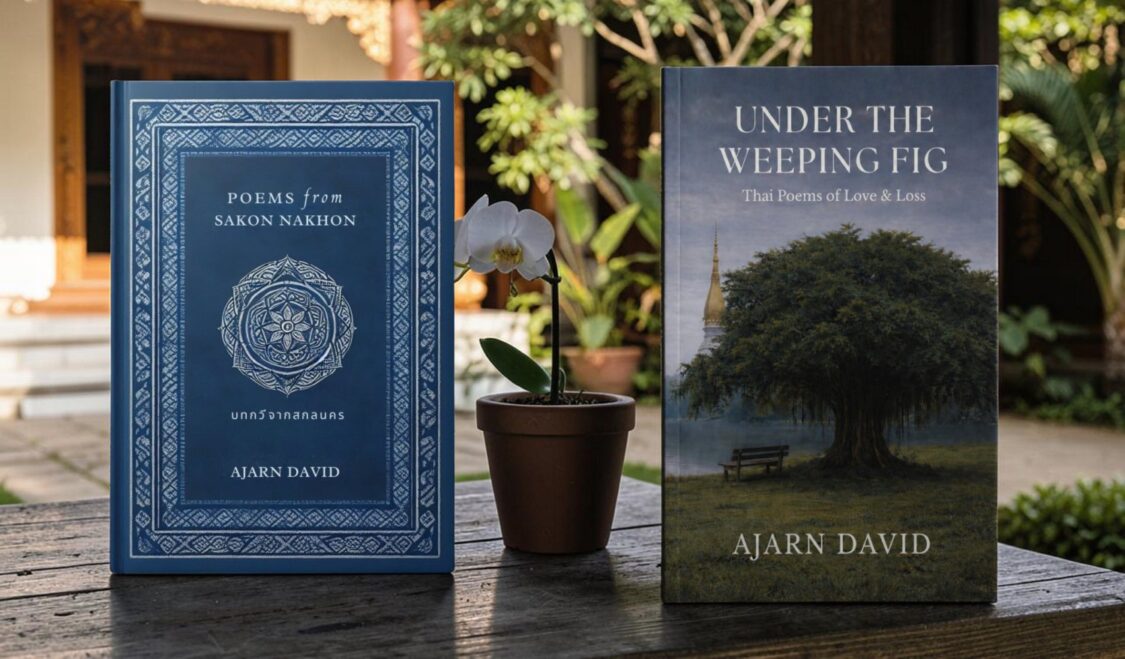
It is against this backdrop that the bilingual Thai-English poetry collections of Ajarn David — a foreign-born writer who has lived and taught in Thailand since 2002 — invite a particular kind of scrutiny. His two collections, Poems from Sakon Nakhon and Under the Weeping Fig, are written entirely in free verse: no fixed meter, no tonal requirements, no classical rhyme schemes. For a literary culture with Thailand’s formal inheritance, the question is worth asking plainly: what does this kind of Thai poetry offer, and by what standards should it be judged?
The Emergence of Plain-Spoken Poetry in the West
The tradition Ajarn David works within has its own long history of discipline and internal argument. The story begins, in part, with Walt Whitman’s great democratic sprawl — poetry that breathed in the cadences of ordinary American speech and refused the inherited corsets of English formal verse. But it is a later generation who most directly shaped what we might call the aesthetics of restraint: William Carlos Williams, Carl Sandburg, Emily Dickinson in her stranger poems, e.e. cummings, and the imagist movement that Ezra Pound helped catalyze in the early twentieth century.
These poets did not abandon formal structures because they found them difficult. They abandoned them because they believed something had been lost — that rhetoric had crowded out perception, that ornament had displaced truth, that the accumulated conventions of English verse had become a wall between the reader and the actual experience the poem was meant to carry. Each found a different way through. What they shared was the conviction that a poem should feel as though it had happened rather than been constructed.
Williams articulated this most bluntly. His declaration — ‘No ideas but in things’ — was not a rejection of meaning but a redirection of it: away from abstraction, toward the concrete object that carries emotional weight without being told to. His poem ‘The Red Wheelbarrow’ has been discussed and argued over for a century because it poses, in the simplest possible terms, a question that turns out to be almost unanswerable:
so much depends
upon
a red wheel
barrow
glazed with rain
water
beside the white
chickens
Sixteen words. No metaphor explicitly named. No emotional instruction given to the reader. The poem insists — through its line breaks, its visual splitting of compound words — that something is at stake here. The insistence is in the structure, not in the rhetoric.
Williams’ ‘This Is Just To Say’ pushes into different territory — the casual domestic note that somehow becomes more than a note:
I have eaten
the plums
that were in
the icebox
and which
you were probably
saving
for breakfast
Forgive me
they were delicious
so cold
and so sweet
The poem appears to be nothing more than an apology. But in the final two lines — ‘so cold / and so sweet’ — the sensory precision transforms everything. Those words enact the pleasure they describe. The poem ends in the mouth.
Pound pushed toward even greater compression. ‘In a Station of the Metro’ — distilled, famously, from a much longer draft over a period of months — is just two lines:
The apparition of these faces in the crowd;
Petals on a wet, black bough.
A crowd in a Paris subway station. A single image drawn from nature. No explanation of the connection. The juxtaposition — faces and petals, crowd and bough — creates something that stays. Meaning produced not through statement but through the energy between two precisely chosen images.
Dickinson worked within her own eccentric system — slant rhyme, hymn meter, unconventional punctuation — but her emotional territory and her resistance to convention place her in this same lineage. Her compression is extraordinary: whole philosophical arguments collapsed into eight lines, whole emotional landscapes rendered through a single paradox. Her poems reward rereading because they are packed with more than the words appear, on first encounter, to contain.
cummings brought typography into the argument — a visual arrangement that slowed the reader down, made the eye and ear work together, found in the spacing and shaping of words on the page a kind of music that conventional typesetting could not produce. His love poems especially — tender, irreverent, playful — showed that emotional intimacy and formal experiment could occupy the same poem.
Sandburg brought the voices of working people — factory workers, farmers, railroad men — into American poetry with a directness that owed much to Whitman but felt like its own thing. His poems are rarely difficult. They are accessible almost immediately. But they are moved by genuine moral concern and by a rhythmic sense rooted in the spoken cadences of the people whose lives they describe.
What these poets share, despite their considerable differences, is a conviction that depth in poetry can emerge from attention and precision rather than formal complexity — that ordinary experience, looked at steadily enough, carries its own weight.
The Misconception of Easiness
The most persistent misunderstanding about free verse is that it is easy to write.
It is not. It is, in some ways, the hardest mode of all — precisely because it removes the structural scaffold that formal verse provides and leaves the poem exposed on every side. In a classical Thai poem written in โคลง, the formal requirements do much of the aesthetic work themselves. When a poet achieves the right tonal pattern, the right syllable count, the right internal rhyme, the poem sounds right because the form has its own beauty. Free verse offers no such cover.
Every line must justify itself on its own terms. Every line break must be earned. The rhythm must be felt even when it cannot be formally described. The silences — the white space, the places where the poem stops and makes the reader wait — must be as carefully placed as the words. And the emotional movement must carry the reader without the reassuring click of rhyme or the anchoring pulse of regular meter.
Weak free verse is everywhere, and it is easy to produce. It mistakes casualness for naturalness, vagueness for depth. It breaks lines without regard for breath or rhythm. It uses imprecise language and calls it honest. The result is writing that gives poetry its bad reputation — and gives traditionalists legitimate grounds for skepticism.
Strong minimalist free verse is something else entirely. It requires spoken cadence that feels natural but is in fact controlled; pacing that moves the reader at the right speed; silence deployed as an expressive element rather than an absence; emotional compression; visual structure that shapes meaning through line arrangement; internal echoes that create coherence without announcing themselves; and the precise placement of ordinary images so that they carry more weight than their apparent simplicity suggests. All of this happening simultaneously, and invisibly.
Richard Hugo, in his writing manual The Triggering Town, describes the obligation a poet has not to settle for the first word that comes, the convenient image, the safe emotion. That obligation is more demanding in free verse than in formal poetry, because the formal poem has external standards by which it can be measured. The free verse poem has only itself.
When a poem appears natural and effortless, it has usually been worked over many times to achieve that appearance. The ornament is gone. What remains is exposed. And what is exposed must be genuine.
Discipline Relocated, Not Removed
When critics of Thai free verse argue that it lacks discipline, they are measuring it against the wrong standard. Free verse does not remove discipline from poetry. It relocates it — away from externally imposed meter and rhyme, toward speech rhythm, precision of imagery, silence, and pacing. This requires different skills, not lesser ones.
The classical Thai poet must master tonal patterns and rhyme schemes refined over centuries. The minimalist free verse poet must master the far less codified art of making language feel alive on the page — finding the exact rhythm a particular poem needs, creating it without the assistance of a fixed metrical template, and shaping the poem’s sonic architecture so that it moves as naturally as breathing. Both are demanding. Neither is the easier path.
Consider again what ‘The Red Wheelbarrow’ actually does. Sixteen words. Every word ordinary. No metaphor, no elevated diction, no formal meter. The poem earns its effect through the tension between the opening claim — ‘so much depends’ — and the completely unpretentious image that follows; through the line breaks that split compound words (‘wheel / barrow,’ ‘rain / water’) and force a slowness that normal reading resists; through the contrast between red and white. All of it invisible craft — the kind that announces itself only through its effects.
Think of what spoken language actually does when it carries emotion. When a person speaks carefully and quietly about something that matters to them, they do not declaim. They choose their words, allow pauses where they need to fall, let silence do some of the work, and trust the listener to hear what is not said as well as what is. The best free verse works this way: intimate, controlled, precise. Closer to a real conversation — conducted quietly between people who are paying attention — than to formal recitation.
Seeing Again: The Power of Ordinary Images
We pass through our days surrounded by objects and moments that carry emotional weight we rarely stop to feel. The fan turning overhead on a hot afternoon. The empty chair at the end of a table. Food cooling in a bowl. The quality of light through a window at a particular time of day. A voice overheard. A gesture glimpsed. A silence that lasted a moment too long. Habit and speed have made these things invisible. What minimalist free verse can do — at its most useful — is make them visible again.
Pound’s metro poem is the most concentrated example: faces in a crowd, rendered through a single image drawn from nature. The connection between the two — faces and petals, crowd and bough — is not explained. It is felt. The poem works because Pound found the precise image that could carry the perceptual charge he was after, and trusted it to do so without comment.
Free verse is, on the whole, better suited to this kind of attention than most formal modes. The requirements of classical Thai verse often push the poet toward the general and the elevated — because the words that fit the tonal pattern or the rhyme scheme are not always the specific, concrete, precisely right words.
Thai free verse makes no such demands. It allows the poet to pursue the most exact image, the most truthful rendering of a moment, without structural compromise.
Contemporary Thai Free Verse and Ajarn David’s Position Within It
Free verse is not new to Thailand. กลอนเปล่า (glon plao) has existed for decades and has produced work of genuine literary seriousness. Modern Thai poets have experimented with fragmented structures, politically engaged verse, socially critical writing, and highly experimental literary language. Poets associated with the movements of the 1970s and the turbulent decades that followed have used free verse to engage with questions of identity, inequality, and historical trauma with considerable sophistication.
Much of this serious contemporary Thai free verse tends, however, toward abstraction, symbolic density, or intellectual difficulty. This is not a criticism — it is an observation about where the tradition has concentrated its energy. The difficult poem, the poem that resists easy reading, the poem that rewards the scholar over the casual reader, holds a recognized and important place in Thai literary discourse. Experimentation signals seriousness.
Ajarn David’s work sits somewhere else on this map. His poems move toward emotional clarity, conversational language, contemplative simplicity, ordinary imagery, and accessibility for readers without specialist literary training. His Thai is often the Thai of everyday speech — not formal or elevated, but the kind a person might actually use in honest conversation. This places him closer to the Anglo-American plain-spoken tradition described above than to the more abstract or experimental tendencies of much contemporary Thai free verse.
This may partly explain why some literary critics receive his work differently from other contemporary Thai free verse. Literary cultures — and this is not unique to Thailand — sometimes more readily accept experimentation when it remains intellectually difficult or stylistically dense, when its difficulty signals membership in a serious literary conversation.
Writing that seeks emotional accessibility through plain language can be perceived as lightweight, regardless of how much craft has gone into achieving that apparent plainness. Williams faced this in America. So did Sandburg. The very simplicity of their work was, for many critics, taken as evidence of its insufficiency.
The question worth holding onto is not whether plain-spoken Thai poetry is simple. It is whether the simplicity is doing genuine work — whether the poem, stripped of ornament, still holds something real.
Two Thai Poems from Ajarn David
Arguments about poetic form can only take us so far without examples. Here are two from Ajarn David’s collections — one from each book.
From Poems from Sakon Nakhon, poem number three:
“ชาติหน้าบ่ายๆ” วลีคุ้นหู
มักพูดเล่นอยู่ให้เห็นขำ
ว่าสิ่งที่ใฝ่ฝัน คุณจะได้พบพาน
ในอีกไม่นาน แค่ตายแล้วเกิดใหม่
แต่วันเดือนปีผ่านไป รวดเร็วสุดใจ
จนถึงวันหนึ่งวันนี้
ที่ “ชาติหน้าบ่ายๆ” หาใช่วลีขำขัน
หากกลับเป็นเหมือนคำมั่น
สัญญาอันประโลมใจ
The phrase ชาติหน้าบ่ายๆ — roughly, ‘next life, perhaps on a lazy afternoon’ — is a familiar Thai expression, usually deployed as a gently ironic dismissal: what you are hoping for will happen only in your next life. The poem begins by acknowledging this: it is a joke, something said lightly. But then time passes — รวดเร็วสุดใจ, with startling speed — and the poem’s final movement performs a quiet philosophical reversal. The same phrase that was once a joke has become something closer to a comforting promise. The poem does not explain this transformation. It simply enacts it, and then stops. The silence after the final line does the work that rhetoric would ruin.
The repetition of ชาติหน้าบ่ายๆ — appearing first as joke and then as comfort — creates an internal echo that structures the whole poem. The movement from light to serious is managed without sentimentality. The poem earns its final feeling because it has earned it through time: the poem’s own compressed time, and the longer lifetime it describes.
From Under the Weeping Fig, poem number ten:
ปล่อยให้ความรักบางเบา
เฉกเช่นเส้นไหมล้อแสง
ไร้น้ำหนัก แต่เมื่อทอบนกี่ชีวิต
มันจะงามละมุน ยิ่งกว่ากลิ่นมะลิยามเช้า
และล้ำค่ากว่าทองคำทั้งโลก
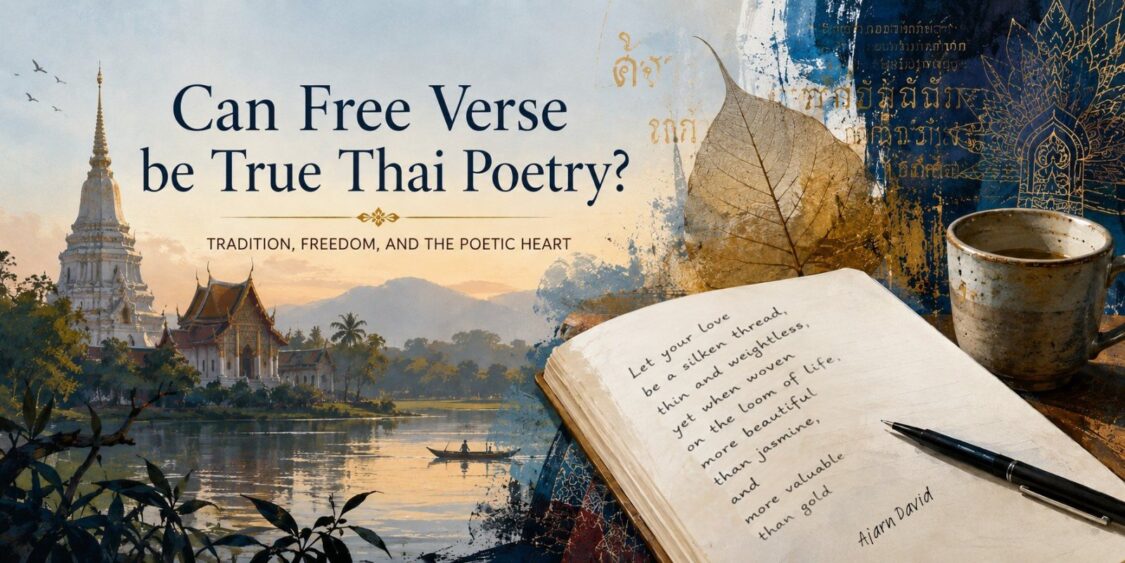
Five lines. The image at the poem’s heart — ความรักบางเบา, love made light and thin as a thread of silk catching the light — is immediately accessible to a Thai reader. Silk carries its own cultural resonance; its lightness and beauty need no explanation. But the poem is doing more than evoking silk: it establishes a tension between the lightness of the thread and the value of what that thread creates when woven. ไร้น้ำหนัก แต่เมื่อทอบนกี่ชีวิต — weightless, yet when woven on the loom of life — the conjunction แต่ pivots the poem from fragility to abundance. The final comparison to jasmine and gold makes explicit what the image had already implied.
The Thai poem is not difficult. Anyone can read it. But the central image is precisely chosen, the pivot carefully timed, the final lines rising without overreaching. Nothing is wasted. And the poem stops where it should — which, in minimalist free verse, is a judgment as important as any word.
The Thai Language, Spoken Musicality, and the Bilingual Imagination
In his preface to Under the Weeping Fig, Ajarn David writes that free verse ‘invites us to linger over the words and thoughts we often rush past in daily life (whether in Thai or English), slowly revealing their beauty and resonance.’ There is something specific being claimed here — not just about poetry in general, but about what free verse can do for Thai readers in relation to their own language. The argument is that it can make ordinary Thai words feel again the way they might have felt when they were first learned: full of sound and weight and meaning, before familiarity made them transparent.
Every language has a layer of ordinary speech that its speakers no longer truly hear. We process the meaning and discard the sound. Poetry, when it works, reverses this — not through obscurity or difficulty, but through attention. A poem that places an ordinary Thai word at the end of a line, surrounded by white space, forces the reader to actually hear that word rather than merely pass through it.
Ajarn David’s bilingual writing process — his mind moving between Thai and English — seems to feed this quality of attention. A person who has learned Thai as an adult, who has worked to understand the tones and connotations of Thai words, often brings to that language a freshness of perception that native speakers must work to recover. This is not to suggest his Thai is more precise or more beautiful than the Thai of native writers. It is only to observe that his relationship to the language carries a trace of the wonder of learning, and that this inflects the poems he writes in it.
His preference for conversational Thai is also a considered aesthetic choice. Classical Thai employs a wide register of elevated Pali- and Sanskrit-derived vocabulary that carries tremendous literary authority but creates, for many readers, a certain distance. Ajarn David’s Thai poetry reaches instead for the language of daily life — words that carry their emotional charge precisely because of their ordinariness. The parallel with what Williams was doing when he wrote about wheelbarrows and plums rather than roses and nightingales is not incidental.
His Thai poetry, read aloud, tends to move in ways that feel like speech: unhurried, aware of the breath, comfortable with silence. There is music in them, but it is the music of a voice rather than a drum or a formal chant. This kind of music is harder to analyze than formal meter — it cannot be reduced to rules and must simply be felt. But when it is achieved, it creates an intimacy that formal recitation rarely matches: the sense of being spoken to directly by someone who is saying something true.
Accessibility as Gateway in Thai Poetry
The suspicion that accessible poetry is somehow less serious than difficult poetry runs deep in many literary cultures, including Thai literary culture. There is a version of this suspicion worth taking seriously: some accessible writing is accessible because it has nothing much to say, and its plainness reflects vacancy rather than restraint. A simple poem can fail just as completely as a complex one.
But accessibility can also be a form of courage — the courage to trust that emotional truth, clearly rendered, is enough. To strip away the complexity that signals seriousness to other scholars, and to stand instead in the direct light of a simple image or a plain statement of feeling, is to accept a kind of exposure that many writers avoid. The poem cannot hide. Everything is visible.
There is also a practical argument. Many ordinary readers — younger readers, bilingual readers, foreigners learning Thai, and many Thai students — find classical Thai poetry genuinely intimidating. Not because they are incapable of appreciating it, but because the formal requirements create a barrier to entry that requires patient guidance to overcome. A reader who has never felt the particular pleasure of a perfectly placed word or a silence that carries more than speech may not be motivated to seek that guidance.
Thai poetry that is emotionally immediate, that speaks in the language of ordinary life, that does not demand specialist knowledge before it can be felt — this kind of writing can create the conditions in which a reader discovers, sometimes for the first time, that poetry is something they want.
And a reader who has discovered they want poetry is, at least potentially, a reader who might eventually encounter กลอน and โคลง and find they want those too. The gateway, if it works, does not end at the door.
How Traditions Survive – Poetry or Cultural
Literary traditions do not survive by remaining static. They survive by remaining alive — by generating work that matters to people, that speaks to actual lives, that finds ways to be relevant to each new generation without abandoning what is most essential about the tradition itself.
The history of poetry involves this kind of continuous transformation everywhere. Latin poetry gave way to the vernaculars — Italian, French, Spanish, English — and each transition brought scholars who lamented the loss of classical discipline, and who were not entirely wrong to do so.
Classical Chinese poetry’s rigid tonal and structural requirements were both preserved and reimagined as Chinese literary culture developed. Japanese haiku, itself a shortened form derived from longer classical genres, became one of the most influential poetic forms in world literary history. In each case, the tradition survived not by resisting change but by absorbing it.
In Thailand, the movement from purely oral to written tradition, and then from purely classical to mixed contemporary forms, has been ongoing for well over a century. The question is not whether Thai literary culture will change — it already has, and will continue to. The question is what it manages to carry forward.
Free verse in Thailand is not a rejection of the Thai literary tradition. It is one possible continuation and expansion of it — an exploration of what the Thai language can do when working with spoken rhythm, ordinary images, and carefully controlled silence rather than classical formal constraints.
The great classical forms will survive. They will survive because their beauty is irreplaceable and because there will always be poets and scholars who love them enough to master them. The real question is whether Thai literary culture can hold both traditions without treating them as competitors.
The Beauty of “Ordinary” Thai Poetry
Return for a moment to poem ten from Under the Weeping Fig — ปล่อยให้ความรักบางเบา. Five lines. “Ordinary” words. A simple image. No claim to formal complexity. And yet it does something: it offers a way of thinking about love that is both practically wise and quietly beautiful, in language that most Thai readers can enter without preparation.
Is this easy to write? In one sense, yes: anyone can read it. But not anyone could write it. The precision of the central image, the timing of the pivot, the restraint of the final lines, the decision to stop where it does — all of this required craft. The craft is invisible, as the best craft always is.
The defenders of classical Thai poetry are right to insist on discipline and precision, right to argue that poetry is an art requiring serious study and dedicated effort. The disagreement — if there is one — is narrower than it might appear. It is not about whether poetry requires discipline. It is about what form that discipline takes. The externally imposed constraints of classical meter and tonal pattern are one rigorous answer to that question. The internal demands of free verse — speech rhythm, emotional compression, precision of image, controlled silence — are another. Both answers are serious. Both are difficult.
Ajarn David’s Thai poetry — modest in its ambitions, accessible in its language, attentive to the overlooked details of ordinary Thai life — participates in a tradition that runs from Williams and Dickinson and Pound and Sandburg to the present: the tradition of the plain-spoken poem that trusts the reader, respects the image, and earns its silence.
Whether his bilingual collections will prove durable is a question only time can answer. But the aesthetic principles from which they proceed are not lightweight. They are, when handled with genuine care, among the most demanding in poetry.
The silken thread is weightless. But woven with care, it holds.
— End —