Thai Poetry Book: Love in a Language That Lets Things Be
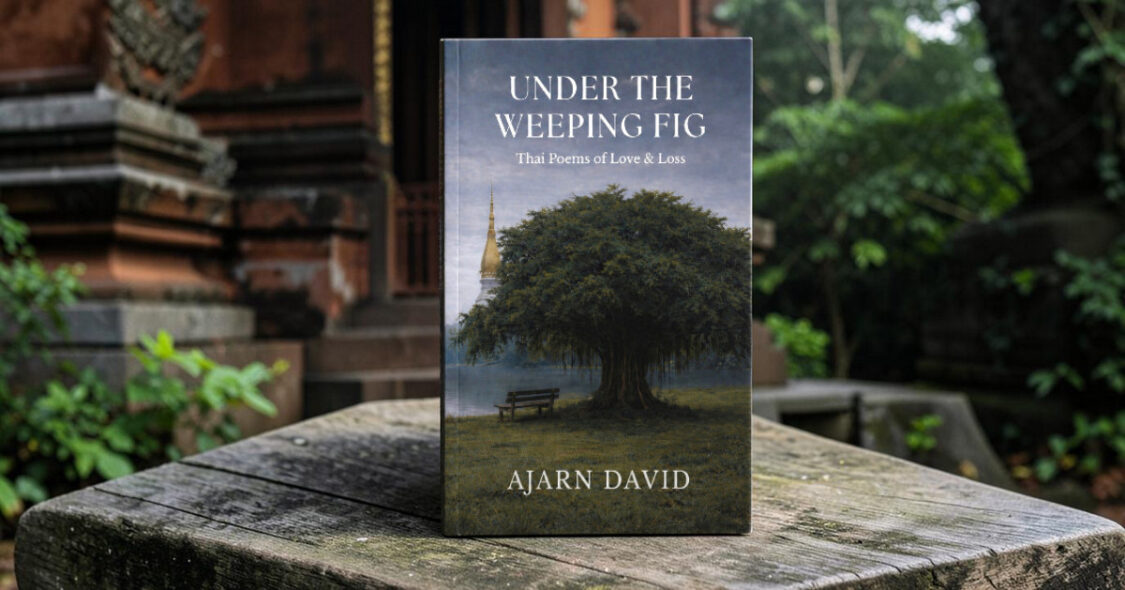
What This Thai Poetry Book Gets Right That Most Bilingual Collections Don’t
Most bilingual poetry collections have a tell. You can feel it almost immediately: one language arrived first, and the other followed at a polite distance, carrying a suitcase of approximations. The translated version is always slightly apologetic. It knows it came second.
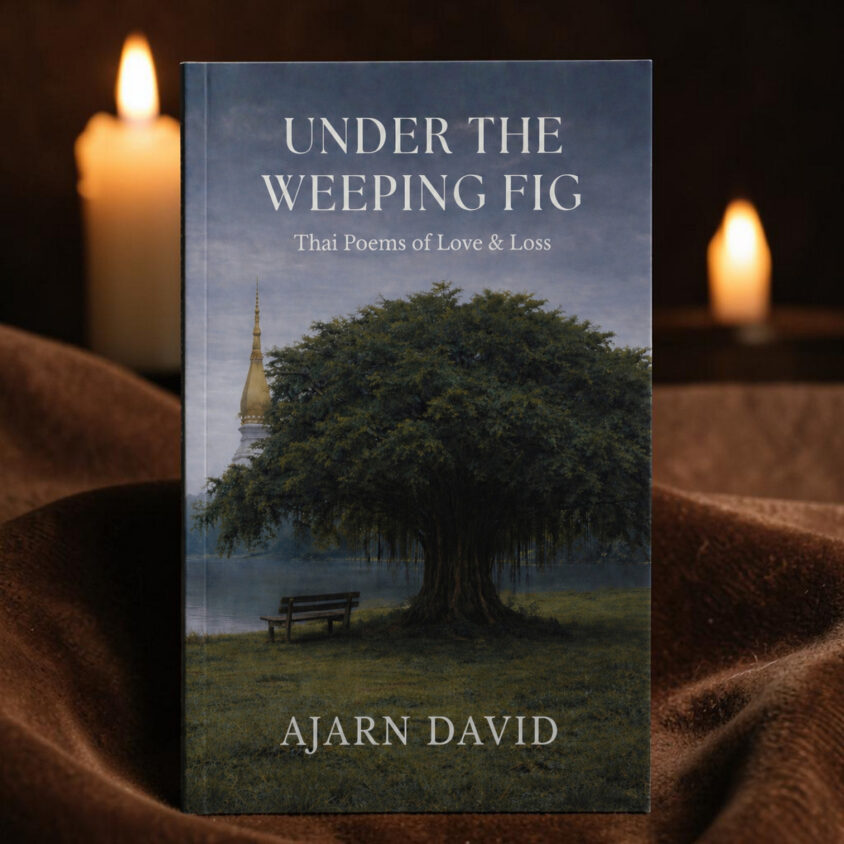
Under the Weeping Fig, a new Thai poetry book from Ysaan Books, does something genuinely unusual: the two versions — English and Thai — were composed simultaneously, the poet’s mind moving back and forth between languages as the poems took shape. The English lines, according to the author, tended to arrive in something close to their final form; the Thai came through as sketches that filled themselves in over time. Two expressions of the same interior moment, each shaped differently by the demands and sensibilities of its language.
The result is a book where neither language shadows the other. Reading across both versions, you’re not following a poem and its translation — you’re catching the same feeling arriving from two directions at once. For anyone who has spent serious time with the Thai language, or who has tried to carry something felt in Thai across into English (or the reverse), that experience will be immediately recognizable as something rare.
Part of what makes it rare is that Thai, as a language, tends to let things be. It doesn’t demand that feelings resolve into conclusions, or that love declare itself, or that ambiguity get tidied up before the poem ends. This Thai poetry book is built on that quality — and the simultaneous composition method is what allows both versions to share it, rather than having one surrender it to the other in translation.
The Voice Behind This Thai Poetry Book
Ajarn David is an American lecturer who has lived in Thailand since 2002. He is a faculty member at Sakon Nakhon Rajabhat University and publishes through Ysaan Books, a small independent press based in Sakon Nakhon — a province that most Thailand guides don’t mention and that most tourists never reach. Before Thailand, he studied in graduate school in North Carolina, published two books of poetry, then spent time in Europe lecturing at the University of West Bohemia in the Czech Republic. He cites Rilke, Hesse, Neruda, and Durrell among his formative literary influences.
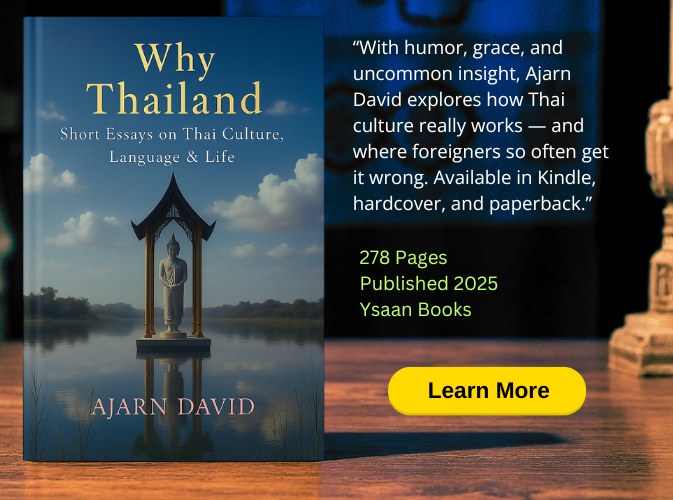
Under the Weeping Fig is his fourth Ysaan Books release, following Why Thailand (a collection of essays on Thai culture and language), published earlier this year. His first release, Poems from Sakon Nakhon, was the inaugural bilingual Thai poetry collection in English published by a long-term expatriate resident, and drew comparisons to the spare, outward-looking traditions of Japanese haiku and Korean sijo. That collection was explicitly about place — the rhythms of rural Isaan life, Buddhist philosophy, and the changing seasons. This new Thai poetry book turns inward, toward the emotional territory that Isaan life also contains but speaks about differently.
It’s worth pausing on what it means to have spent more than two decades in Northeast Thailand and to write from that position. Isaan is a region that tends to produce expats of a particular kind — people who stopped treating Thailand as a backdrop and started inhabiting it as a life. After that long, you develop an instinct for how affection moves through interaction here: obliquely, through gesture, through the timing of things said and unsaid. The Thai love poems in this collection are shaped by that instinct.
Thai Poetry Grounded in Specific Places
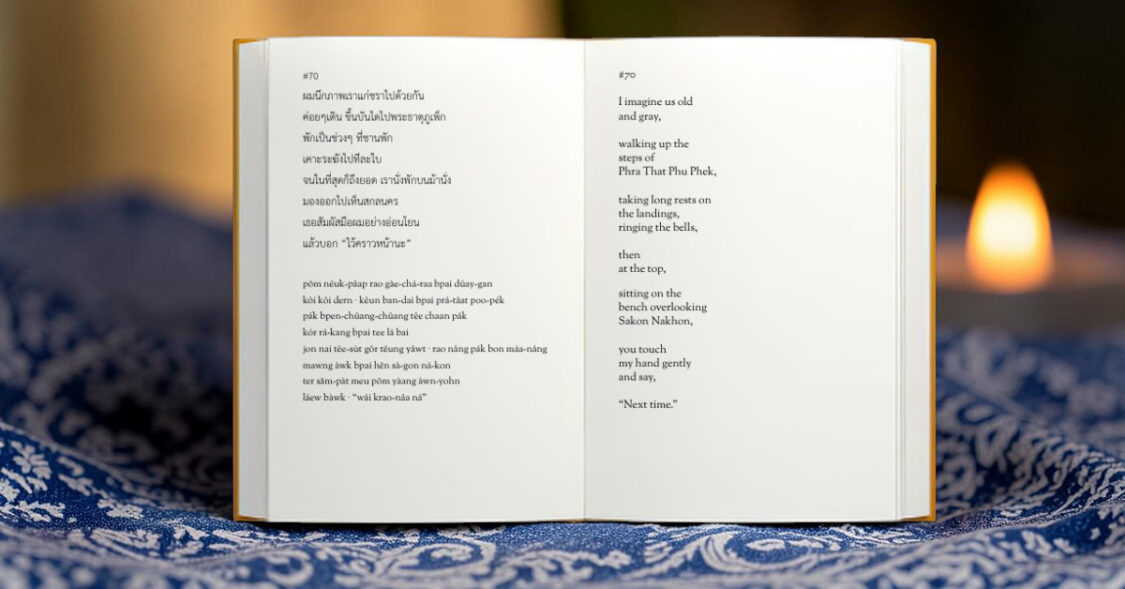
The poems don’t float. They’re set in specific places: Chiang Khan’s riverside promenade, the great skywalk that curves above the Mekong, the pilgrimage steps climbing toward Phra That Phu Phek outside Sakon Nakhon, the shores of Nong Han Lake. Anyone who knows Isaan will recognize these immediately, without needing them explained. For readers who don’t, the places function differently — not as landmarks but as evidence. This is someone writing from inside a life, not describing one from the outside.
Poems about love with no identifiable geography tend to drift. These don’t. The emotions have somewhere to stand — a particular riverbank at a particular hour, a temple staircase with a particular view. That rootedness is doing real work. It’s the difference between feeling described and feeling located.
One poem is organized around a dream of spending just a single day with someone in Chiang Khan. The Thai closing line — แค่วันเดียว ก็พอแล้ว — carries a quality that “just for a day” doesn’t quite match in English. The Thai settles into the limitation rather than straining against it. There’s a Buddhist comfort with finitude in that phrase that the English can gesture toward but not fully hold. That gap between versions, replicated throughout the collection, is one of this Thai poetry book’s most consistently interesting qualities.
What Thai Poetry Reveals That English Can’t Easily Express
One poem in the collection turns explicitly to the question of what language does to feeling. It sets the English term “unrequited love” alongside the Thai รักข้างเดียว — “one-sided love” — and makes a careful case for why the Thai is more honest. The English “unrequited” is dense with expectation and its disappointment; it implies that love has been submitted and rejected, a transaction gone wrong. The Thai simply locates the love on one side. It doesn’t complain. It doesn’t require reciprocity to be complete.
This is the kind of observation that sounds small until it opens up. The language we use to name feelings shapes the feelings we’re capable of having. Thai tends toward ambiguity and incompleteness in ways that English frequently resists. English wants resolution; it wants the arc to close. Thai is more comfortable leaving the door open, the moment unfinished, the conclusion unannounced. These poems live in that space — present but unexplained, felt but not argued.
For readers with any serious investment in the Thai language, this dimension of the book will feel like recognition. Thai has entire emotional registers — kreng jai, nam jai, the wordless implications of graded pronouns — that English can describe but can’t quite reproduce. A poet writing simultaneously in both languages is necessarily navigating those registers all the time, making choices that reveal something about how feeling and expression shape each other across cultures. And running beneath all of those choices is the same disposition: Thai lets things be. It doesn’t insist. It doesn’t push feelings toward conclusions they haven’t earned.
Seventy-Two Movements Through One Feeling
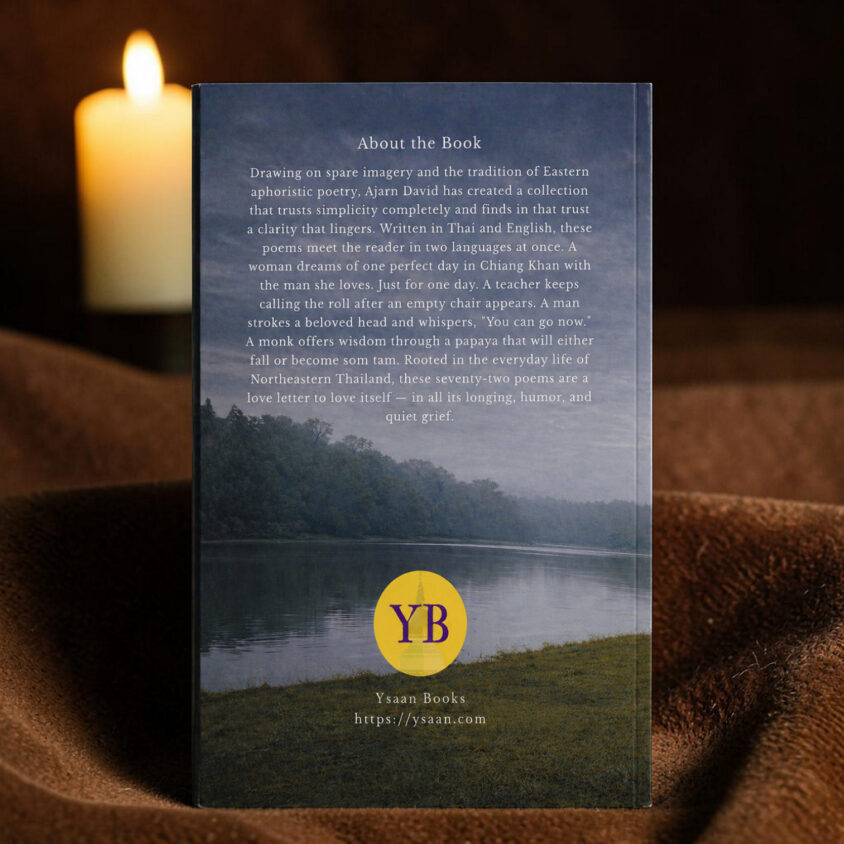
The collection contains seventy-two poems. Reading them in sequence, a pattern emerges that the subtitle — Thai Poems of Love & Loss — only partly describes. The second person across these poems — “you,” เธอ, น้อง — refers with unusual consistency to what feels unmistakably like the same person. Not a generalized beloved, not a shifting cast of loves. One woman, encountered across seventy-two angles of approach.
She has chubby cheeks and doesn’t see her own beauty. Her motorcycle appears. She has a Facebook presence that resurfaces precisely when he has almost stopped thinking of her. She forgets plans they had made and cries “But I forgot!” when gently reminded. She has a name the poems never give us, and yet by the end we know her extremely well.
The love is consistently one-directional. And in a sense, the entire collection could be considered a book of unrequited love poems. The poet attends; the beloved moves through her life at a different angle. What’s striking is that this asymmetry is never treated as failure. Poem after poem returns to the question of what it means to love fully without expectation of return — and arrives, gradually, at something that isn’t resignation but genuine sufficiency. The feeling is enough. Not because anything has been resolved, but because the capacity to feel this attentively, and write this honestly, turns out to be its own form of completion.
This is where the Thai Buddhist context does something the Western literary tradition of unrequited love rarely manages. Goethe’s Werther, perhaps the most famous treatment of the subject in European literature, presents unreturned love as totalizing and ultimately fatal. Werther cannot love Charlotte without being consumed; the tragedy is less the love’s asymmetry than his inability to survive it.
The poems in Under the Weeping Fig are shaped by a different understanding: that attachment to particular outcomes — including reciprocity — is itself the source of suffering, and that love which has released that attachment hasn’t diminished but purified itself. รักข้างเดียว. One-sided love. Not failed love. Love that is complete on its own side. Love, in other words, that has learned to let things be.
Plainness as a Practice in Thai Poetry
In his introduction, the poet writes that the longer he has lived in Thailand, the more he has come to value fewer and simpler words. That value is legible on every page. The poems are short — sometimes very short — and stripped of decoration. No elaborate metaphors, no heavy rhetorical machinery. A line break does the work another writer might spread across a stanza.
This kind of plainness is harder to achieve than it looks, relying on a single image to hold an entire emotional situation. The restraint Ajarn David shows is itself a formal argument about how feeling moves in this culture: through presence, through gesture, through the precisely weighted pause.
There’s humor throughout, too, which matters more than it might seem. The literature of unrequited love has a persistent tendency toward solemnity. Werther doesn’t laugh. Petrarch, writing his sonnets to Laura across decades of her inaccessibility, doesn’t laugh. But actual human beings in the grip of one-sided love are frequently funny about it, at least some of the time — rueful, self-aware, capable of stepping back and watching the absurdity of their own position. The hopeless romantic in one poem is tormented by competing inner voices. The friend zone is compared to the sixth circle of hell. A rabbit face on Facebook resets ninety days of not thinking about her. These poems make room for that humor, and it prevents the collection from becoming suffocating.
A Thai Poetry Book That Belongs Here
Ysaan Books occupies an unusual space in Thailand’s small literary ecosystem. Its mission — to promote the arts, culture, and people of Isaan through literature and poetry — is one that international publishers haven’t rushed to fill. The region doesn’t generate a lot of literary attention from outside. Its temples, its festivals, its monks, its agricultural rhythms: these are well-documented by anthropologists, less so by poets writing in a way that’s accessible to both Thai and international readers simultaneously.
What Ajarn David has developed across his Ysaan Books releases is a distinctive position critics have called an “outsider-insider” perspective — someone with enough distance to notice what locals take for granted, and enough immersion to write from within rather than above. Poems from Sakon Nakhon established that position in relation to place. Under the Weeping Fig extends it into emotional territory that is, if anything, harder to navigate: the interior life of love in a culture that speaks about feeling indirectly, through exactly what’s not said.
It would be impossible to compare Ajarn David to legendary Thai poets such as Sunthorn Phu and Angkarn Kalayanapong, for he thoroughly departs from Thai classical meter and rhyme schemes, as well as literary language, to write in free verse and everyday Thai. That break from tradition is not a weakness but a choice: it allows the poems to move at the pace of spoken language, of thought, of the kind of feeling that arrives before you have time to arrange it properly. It also allows this Thai poetry book to be genuinely readable for international audiences — not just specialists.
A Language That Lets Things Be
For readers who’ve lived in Thailand, particularly in the Northeast, there’s an additional pleasure available in Under the Weeping Fig: the pleasure of recognition. The riverside at dusk, the temple bells carried on a particular kind of evening air, the specific quality of affection communicated through the things no one says out loud. Under the Weeping Fig (and Poems from Sakon Nakhon before it) puts words to feelings that Thailand — and Thai — have always known how to hold. It just usually doesn’t announce them.
That, finally, is what the title of this review is reaching for. Thai is a language that lets things be — that allows love to exist without needing to become something else, that allows a feeling to settle at one-sided without that being a verdict, that allows a poem to end without having resolved what it set out to say. These are not failures of expression. They are a different understanding of what expression is for. Ajarn David has spent twenty-plus years inside that understanding, and this collection shows what it looks like when a poet has genuinely absorbed it rather than merely observed it from a comfortable distance.
Under the Weeping Fig is available internationally on Amazon in paperback, hardcover, and Kindle. For readers in Thailand, the paperback is also available through Ysaan Books’ Lazada and Shopee stores. It’s the kind of Thai poetry book that rewards reading once through quickly, then again more slowly — once to feel the arc, once to catch everything the brevity is concealing.