Thai Love Poems: New Bilingual Book from Ysaan Books
Love in Thailand is often quieter than people expect. It doesn’t announce itself. It shows up in timing, in small gestures, in what’s left unsaid — a plate of food placed without asking, a pause that carries more meaning than anything spoken.
For those who’ve spent time in the Northeast, in Isaan, this becomes familiar over time. The way feeling moves through routine rather than declaration. The way affection is shown through presence rather than words. But it’s hard to explain to someone who hasn’t experienced it, and harder still to translate into another language and another way of seeing.
Which is partly why poetry exists.
A Bilingual Collection of Thai Poems Written Simultaneously
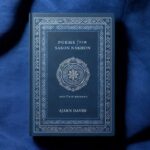
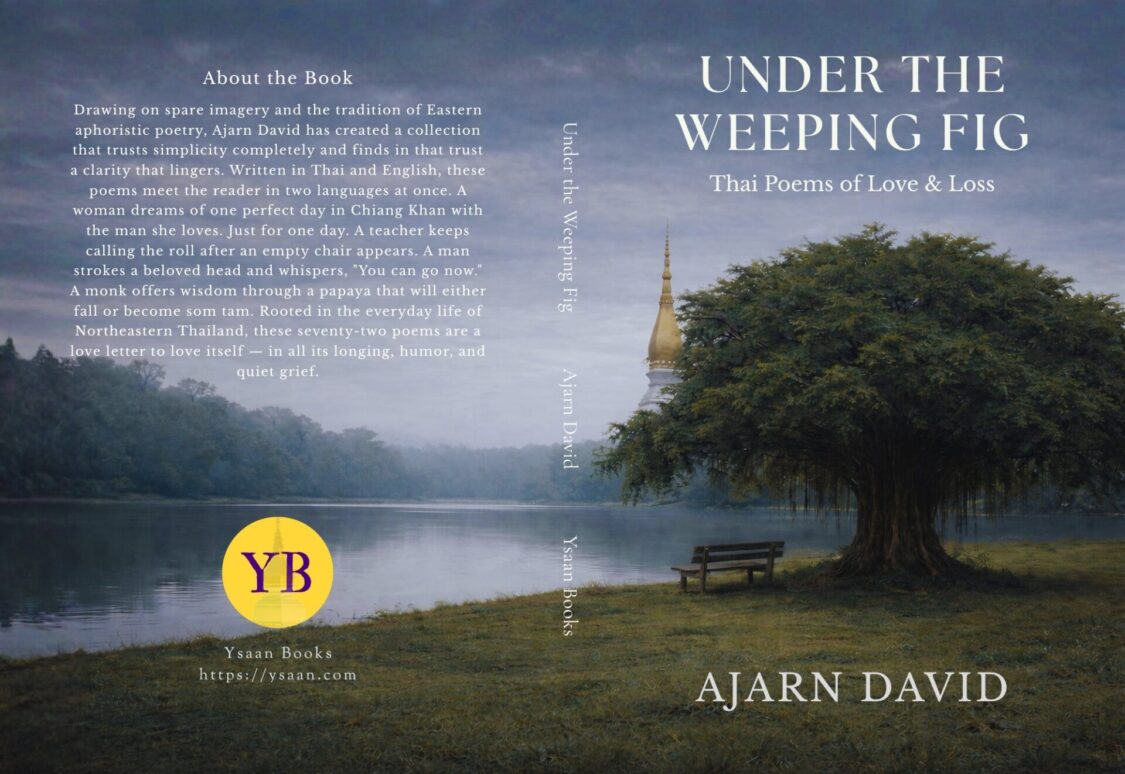
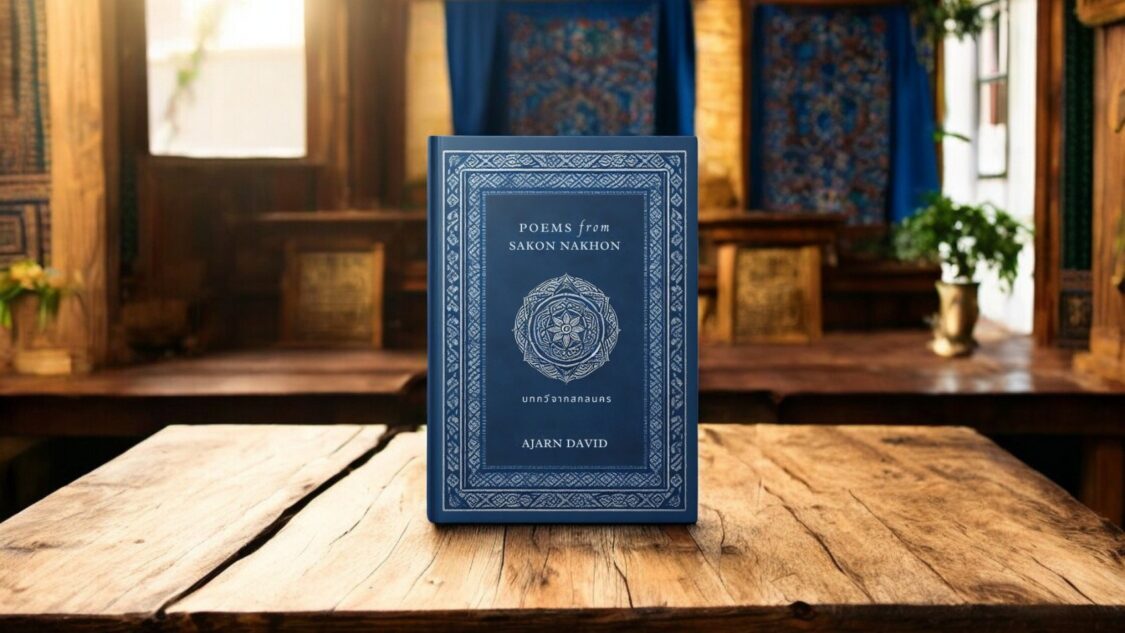
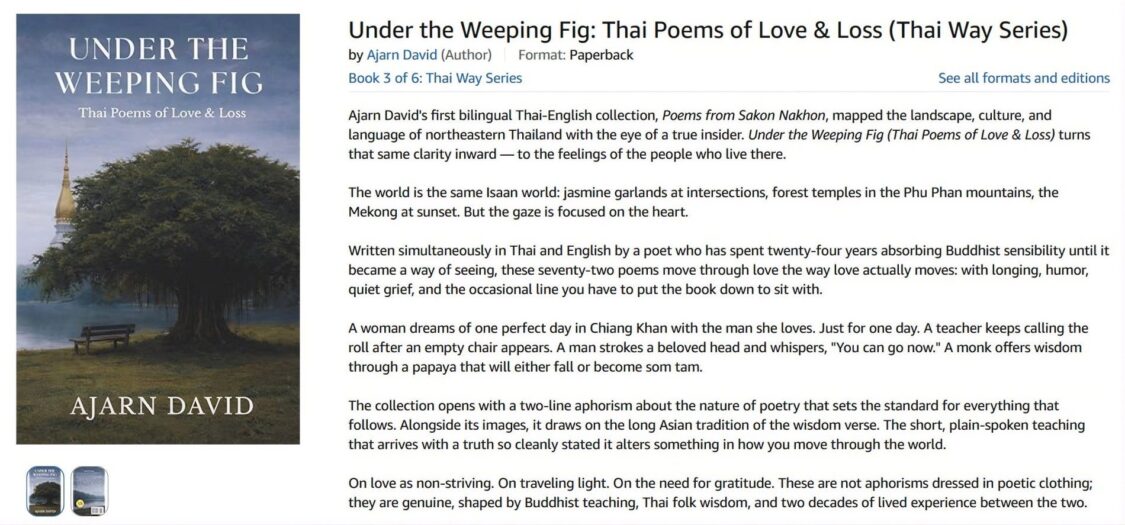
Under the Weeping Fig (Thai Poems of Love & Loss), a new bilingual poetry collection by Ajarn David — author of Poems from Sakon Nakhon — takes an unusual approach to that problem. The poems weren’t written in one language and translated into the other.
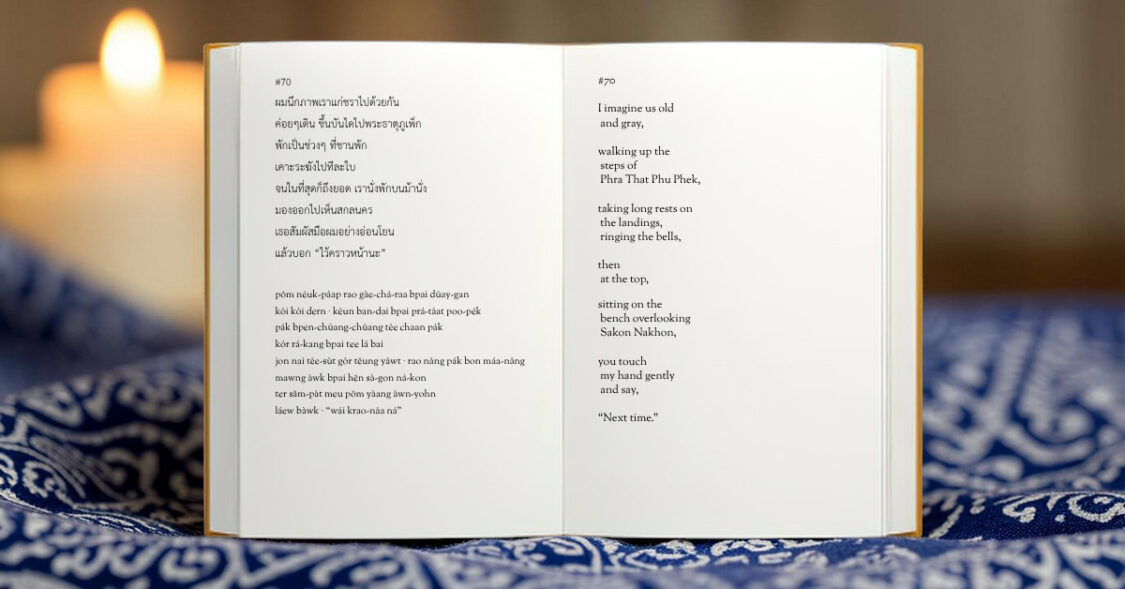
They instead were often written close to simultaneously, his mind moving back and forth between Thai and English. The English poems tended to arrive nearly complete; the Thai emerged as rough sketches that he’d fill in and refine. Two expressions of the same moment, shaped differently by each language.
That distinction changes how the book reads. In most bilingual poetry collections, one language leads and the other follows — and you can feel it. Here, neither version feels like a shadow of the other. The English doesn’t simplify the Thai, and the Thai doesn’t trace the English line by line. Reading across both versions, you’re not encountering a poem and its translation. You’re encountering the same feeling twice, arriving from slightly different directions.
Thai Love Poems Rooted in Real Isaan Places
The love poems themselves are grounded in specific places — Chiang Khan’s riverside promenade, the skywalk above the Mekong, the pilgrimage steps of Phra That Phu Phek outside Sakon Nakhon. Anyone who knows Isaan will recognize these settings without needing them explained. For those who don’t, they work differently — less as landmarks and more as evidence that someone is writing from inside a life rather than outside one looking in.
This matters more than it might seem. Poems about love that are set nowhere in particular tend to float. These don’t. They’re attached to a particular riverbank, a particular temple, a particular kind of evening in Northeast Thailand. That rootedness gives the emotion somewhere to stand.
One poem is built around a dream of spending just a single day with someone in Chiang Khan. The Thai closing line — แค่วันเดียว ก็พอแล้ว — carries an acceptance that the English “just for a day” doesn’t quite match. In Thai, there’s a settling into that limitation rather than a resistance to it. That small gap between the two versions says a lot about what makes this collection worth reading in both languages.
What Thai Reveals That English Can’t Easily Express
That gap between languages is something the book keeps returning to, and it’s one of its most valuable qualities — particularly for readers with any interest in the Thai language or culture.
One poem takes the gap on directly, comparing the English “unrequited love” to the Thai รักข้างเดียว — one-sided love — and making a quiet case for why the Thai is better: less needy, more like love itself. It’s a small observation that opens up into something larger about how the language we use shapes the feelings we’re able to have.
Thai tends to be more comfortable with ambiguity and incompleteness than English. English wants resolution. Thai is more willing to let things remain open, unnamed, unfinished. These poems live in that space. Feelings are present but not always explained. Things happen and then pass. What remains is an impression rather than a conclusion — which, if you’ve spent time in Thailand, is exactly how a lot of emotional life there actually feels.
The Emotional Range of These Thai Love Poems
Published by Ysaan Books, this collection covers a wide range of feeling, but the approach stays consistent throughout: short lines, plain language, nothing decorative. There’s a poem about a woman who can’t quite believe what she sees when she looks at him looking at her. Another refuses the romantic idea of loving someone with all his heart, and offers something more honest and more fragile instead. One captures the particular anxiety of someone whose feelings have always burned too intensely for their own comfort. Another is built around a joke that turns out not to be a joke at all.
There are also love poems about loss — not the dramatic, sudden kind, but the quieter sort. The kind that settles in gradually through absence and silence and the continuation of ordinary days. And several that sit somewhere between love and loss simultaneously, which is where a lot of the most interesting emotional territory tends to be.
Modern Poetry Written Simply — and Why That Takes Skill
Ajarn David writes in his introduction that the longer he has lived in Thailand, the more he has come to appreciate the power of fewer and simpler words. That preference shows throughout the collection. The poems are short, sometimes very short — and compression at that level is harder than it looks.
There’s a risk with this kind of plainness that it tips into the sentimental. But the poet deftly handles sentimentality without apology. And more often than not the brevity earns its weight. A line break does the work that another writer might use three sentences for. A single image carries an entire emotional situation. That restraint is itself a kind of argument — about how feeling moves in Thailand, about what poetry can do when it stops trying to impress.
An Unexpected Ending to a Thai Poetry Collection
The book closes with an epilogue that earns its place. Shortly after finishing the poems, the author retreated to the Phu Phan mountains for a five-day fast, staying in a small kuti at a forest temple near the Phu Pha Yon National Park. What happens there — a dream, a walk deeper into the forest, an encounter he wasn’t expecting — leads to a conclusion that says more plainly what the poems have been circling around all along.
It’s an unusual way to end a poetry collection. But it fits. The whole book has been moving toward something — not a resolution exactly, but a settling. The epilogue provides it, in the most unexpected way possible.
Where to Find This Bilingual Collection of Poems
Under the Weeping Fig is available internationally on Amazon in paperback, hardcover, and Kindle. For readers in Thailand, the paperback is also available through Ysaan Books’ stores on Lazada and Shopee.
View Under the Weeping Fig on Amazon

- Thai Music Genres Explained: T-Pop, Luk Thung, Mor Lam and More - September 16, 2026
- Thailand Music Festival Guide: Late 2026–Early 2027 - September 14, 2026
- Discover Thai Music: A Beginner’s Guide and Song Playlist - September 9, 2026