Reframe Your Brain for Thai Learning

There comes a point when learning Thai that progress slows down, even though you are still putting in effort.
You know vocabulary.
You understand sentence structure.
You can follow conversations.
And yet, Thai sentences like this still stop you:
เมื่อก่อนเขาเป็นเด็กเกเร พอโตมากลับประสบความสำเร็จ
→ He used to be a troublemaker, but when he grew up, he ended up becoming successful.
Not because they are complex.
But because your brain reacts too quickly—and in the wrong direction.
This is something almost every English speaker runs into at some point.
It is not a vocabulary problem.
It is a processing problem.
How English and Thai Process Meaning Differently
English trains you to read like this:
word → meaning → sentence
Each word carries a relatively stable meaning. You stack them, and the sentence forms.
Thai doesn’t build meaning the same way.
Thai is an analytic language where meaning is often determined by context, position, and surrounding elements—not by fixed word forms.
Even more importantly:
Many Thai words don’t carry fixed meaning on their own—they guide how meaning develops across the sentence.
Some words act like signals:
- timing
- transition
- completion
- contrast
- attitude
signals that shape how a sentence unfolds.
Learning Thai: Why You Keep Getting Stuck
Let’s take the second half of the sentence:
พอโตมากลับประสบความสำเร็จ
Your brain hears:
- พอ → “enough”
- มา → “come”
- กลับ → “go back”
And it locks those meanings immediately.
But here’s the problem:
Those meanings are wrong in this context.
So now your brain has to:
- Undo the incorrect meaning
- Rebuild the sentence from scratch
That’s why many learners feel they can understand Thai—but only after struggling.
The Core Issue: Why Thai Sentences Feel Confusing
Your brain is doing this:
hear word → assign meaning → continue
But understanding Thai requires:
hear chunk → recognize direction → refine meaning
You are committing too early.
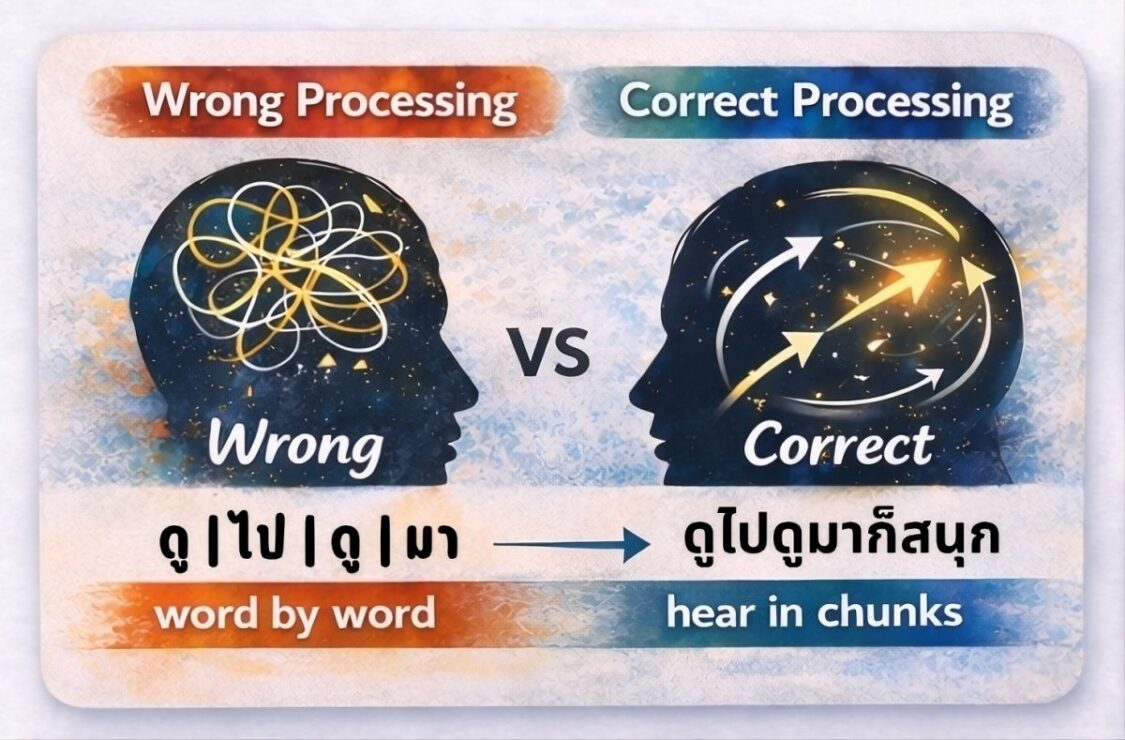
The New Mindset: Listen in Chunks, Not Words
This is the shift that makes Thai start to make sense.
Stop listening word by word.
Thai becomes much easier to understand when you hear it in chunks.
For example, instead of processing:
พอ | โต | มา | กลับ | ได้ดี
train yourself to hear:
พอโตมา | กลับได้ดี
Once you hear Thai in chunks, the meaning becomes much clearer.
You don’t need to stop understanding words.
You need to hold their meaning loosely until the full chunk is complete.
Also, an important shift:
You are not supposed to fully understand the sentence halfway through.
Thai often resolves meaning at the end. Let the sentence finish before you decide what it means.
The Core Function Markers You Must Reframe
These are the markers that confuse almost everyone at first—but once you see how they work, things start to click.
1. พอ → Trigger Point
Marks the moment something happens that leads directly to a result. Not “enough”
Think:
“once / as soon as / at that moment”
Example:
พอได้ลองกินก็ชอบเลย
→ The moment I tried it → I liked it immediately
2. มา → Continuation / Development
Shows something developing over time (often toward the present perspective). Not just “come”.
Think:
“as things progressed / over time”
Example:
โตมาเป็นคนขยัน
→ As he grew up → he became a hardworking person
3. ไป → Ongoing Progression / Drift
Shows something continuing forward or unfolding over time.
Think:
“as it continues / moving along”
Example:
คิดไปคิดมาก็เริ่มเข้าใจ
→ Thinking it through → eventually began to understand
4. กลับ → Reversal / Unexpected Shift
Signals that the outcome goes against expectation. Not just “return”.
Think:
“unexpectedly / turns out / instead”
Example:
นึกว่าจะไม่ชอบ แต่ลองแล้วกลับติดใจ
→ Thought I wouldn’t like it → but ended up loving it
5. ได้ → Result / Successful Outcome
Marks that something was achieved, completed, or worked out.
Think:
“ended up / managed to / successfully”
Example:
ฝึกไปฝึกมาก็พูดได้คล่อง
→ Practiced over time → ended up speaking fluently
6. ก็ → Natural Result / Flow Connector
Links cause → effect in a natural, expected way
Think:
“then / so / naturally”
Example:
พอมีเวลาก็อ่านหนังสือ
→ When I have time → I read
7. อยู่ → Ongoing State
Shows something continuing or in progress.
Think:
“still / currently / ongoing”
Example:
เขายังเรียนอยู่
→ He is still studying
8. เอง → Emphasis / Personal Resolution
Adds a sense of “it just turned out that way” or personal emphasis
Example:
อยู่ไปอยู่มาก็ชอบเอง
→ Over time → I just ended up liking it.
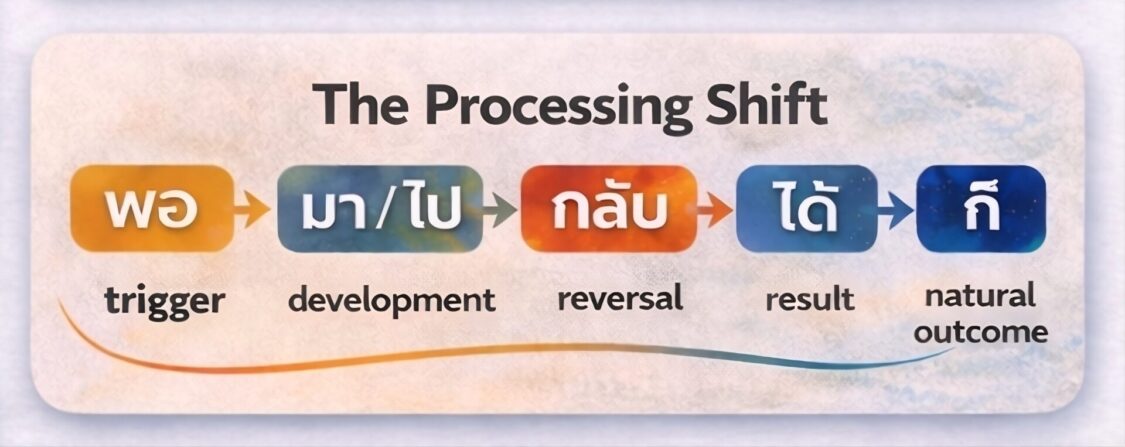
The Pattern You Must Learn to See
Many Thai sentences follow this structure:
initial state → change → shift → result
And these markers:
- พอ
- มา / ไป
- กลับ
- ได้
- ก็
are what guide that movement.
Why Native Speakers Don’t Struggle
Because they don’t treat Thai function markers as fixed meanings.
They process them automatically as part of a larger pattern.
Instead of hearing one word and locking into one meaning, they take in the sentence as it unfolds and recognize the direction naturally.
They feel the pattern immediately.
The Training Method
Listen in chunks, not individual words
Train yourself to group words together and process them as a unit
Focus on directional markers
Pay attention to words like พอ, มา, ไป, กลับ, ได้, ก็
These don’t have one fixed meaning—they tell you where the sentence is going
Delay commitment, not understanding
Allow meaning to form, but do not lock into the first interpretation of these markers
Use the ending to confirm meaning
The final part of the sentence often reveals how the earlier markers should be understood
Watch how the direction develops
- พอ signals a trigger point
- มา and ไป show progression
- กลับ signals a reversal
- ได้ marks a result
- ก็ connects cause to outcome
Let meaning adjust as you go
Be willing to revise your interpretation as the sentence unfolds based on these signals.
Drill Set for Reframing Your Brain
For each sentence:
- Read the full sentence once
- Mentally group it into chunks
- Notice the directional markers:
- พอ = trigger
- ไป / มา = progression
- กลับ = reversal
- ได้ = result
- ก็ = natural outcome
Ask: what changed? Then let meaning form.
Drill Set 1: Reversal After Development
เมื่อก่อนเขาไม่ชอบกาแฟ พอลองดื่มไปเรื่อยๆ กลับติดใจ
(markers: พอ = trigger, ไป = progression, กลับ = reversal)
→ He didn’t like coffee before, but after trying it over time, he ended up loving it.
ตอนแรกผมคิดว่ายาก ทำไปทำมากลับง่ายกว่าที่คิดไว้
(markers: ไป/มา = progression, กลับ = reversal)
→ At first I thought it was difficult, but after doing it repeatedly, it turned out easier than I expected.
แรกๆ เขาดูเงียบ ๆ คุยไปคุยมากลับพูดเก่งมาก
(markers: ไป/มา = progression, กลับ = reversal)
→ At first he seemed quiet, but after talking more, he turned out to be very talkative.
เมื่อก่อนเขาไม่ตั้งใจเรียน โตมาแล้วกลับประสบความสำเร็จ
(markers: มา = development, กลับ = reversal)
→ He didn’t take studying seriously before, but as he grew up, he ended up becoming successful.
ตอนแรกไม่อยากไป พอไปจริง ๆ กลับสนุกมากกว่าที่คิด
(markers: พอ = trigger, กลับ = reversal)
→ At first I didn’t want to go, but once I actually went, it turned out to be more fun than I expected.
Drill Set 2: Gradual Shift → Natural Result
แรก ๆ ฟังไม่ค่อยออก ฟังไปฟังมาก็เริ่มเข้าใจมากขึ้น
(markers: ไป/มา = progression, ก็ = natural result)
→ At first I couldn’t understand much, but after listening more and more, I gradually started to understand better.
ตอนแรกยังไม่ชิน ใช้ไปใช้มาก็เริ่มรู้สึกง่ายขึ้น
(markers: ไป/มา = progression, ก็ = result)
→ At first I wasn’t used to it, but after using it more, it started to feel easier.
ช่วงแรกยังไม่มั่นใจ ทำไปทำมาก็เริ่มดีขึ้นเรื่อยๆ
(markers: ไป/มา = progression, ก็ = result)
→ At first I wasn’t confident, but after practicing more, things gradually improved.
ดูไปดูมาก็เริ่มสนุกขึ้นโดยไม่รู้ตัว
(markers: ไป/มา = progression, ก็ = result)
→ The more I watched, the more it became enjoyable without realizing it.
คุยไปคุยมาก็สนิทกันมากขึ้น
(markers: ไป/มา = progression, ก็ = result)
→ The more we talked, the closer we became.
Drill Set 3: Trigger → Immediate Outcome
พอได้ลองกินก็ชอบเลย
(markers: พอ = trigger, ก็ = immediate result)
→ As soon as I tried it, I liked it immediately.
พอรู้ความจริงก็เข้าใจทุกอย่างทันที
(markers: พอ = trigger, ก็ = result)
→ Once I knew the truth, everything made sense immediately.
พอมีโอกาสเขาก็รีบทำเลย
(markers: พอ = trigger, ก็ = natural action)
→ As soon as he had the chance, he quickly acted.
พอคิดดี ๆ ก็ไม่น่ากลัวอย่างที่คิด
(markers: พอ = trigger, ก็ = conclusion)
→ When I thought about it carefully, it wasn’t as scary as I thought.
พอได้ยินแบบนั้นก็รู้สึกแปลกๆ
(markers: พอ = trigger, ก็ = emotional result)
→ When I heard that, it felt a bit strange.
Drill Set 4: Mixed Patterns (More Natural Flow)
เมื่อก่อนผมไม่ชอบตื่นเช้า แต่พอฝึกไปเรื่อยๆ กลับรู้สึกสดชื่นขึ้น
(markers: พอ = trigger, ไป = progression, กลับ = reversal)
→ I used to dislike waking up early, but after practicing it over time, I started to feel more refreshed.
ตอนแรกคิดว่าจะเบื่อ แต่ดูไปดูมากลับเพลินจนหยุดไม่ได้
(markers: ไป/มา = progression, กลับ = reversal)
→ At first I thought it would be boring, but the more I watched, the more I got hooked and couldn’t stop.
แรกๆ ยังไม่เข้าใจ แต่เรียนไปเรียนมาก็เริ่มเห็นภาพชัดขึ้น
(markers: ไป/มา = progression, ก็ = result)
→ At first I didn’t understand, but after studying more, things started to become clearer.
เมื่อก่อนเขาไม่พูดเยอะ แต่พอสนิทกันมากลับพูดไม่หยุด
(markers: พอ = trigger, กลับ = reversal)
→ He didn’t talk much before, but once we became close, he ended up talking nonstop.
ตอนแรกไม่มั่นใจเลย แต่ทำไปทำมาก็เริ่มมั่นใจขึ้นเอง
(markers: ไป/มา = progression, ก็ = result, เอง = natural resolution)
→ At first I had no confidence, but after doing it more, I naturally became more confident.
Your New Thai Mindset
What you’re really training here is how your brain handles the sentence in real time. Not what words mean, but how you process them as they come in. The goal is to stop reacting to each word and start following the movement of the sentence. Once you get used to hearing Thai in chunks, and seeing things like พอ, มา, ไป, กลับ, ได้, and ก็ as signals instead of fixed meanings, things start to loosen up. You won’t get stuck the same way. You’ll just start to feel where the sentence is going, and the meaning will come with it.

- How I Wrote “Rak Sakon Nakhon”: A Thai Song for the Road Home - September 12, 2026
- Easy Thai Songs to Sing & Learn for Karaoke - September 5, 2026
- Reframe Your Brain for Thai Learning - April 18, 2026