Thai Poetry Book is Beating the Guidebooks
A bilingual collection from one of Thailand’s least-known provinces is finding readers worldwide — and opening a window onto a culture most visitors never see.
Most people’s mental image of Thailand runs on a short loop: the temples of Bangkok, the limestone cliffs of Krabi, the night markets of Chiang Mai. Sakon Nakhon doesn’t appear anywhere in that reel. It’s a landlocked province on the northeastern plateau, close to the Laos border, known among Thais for ancient forests, revered monasteries, and some of the finest textile traditions in the country. International visitors rarely make it there.
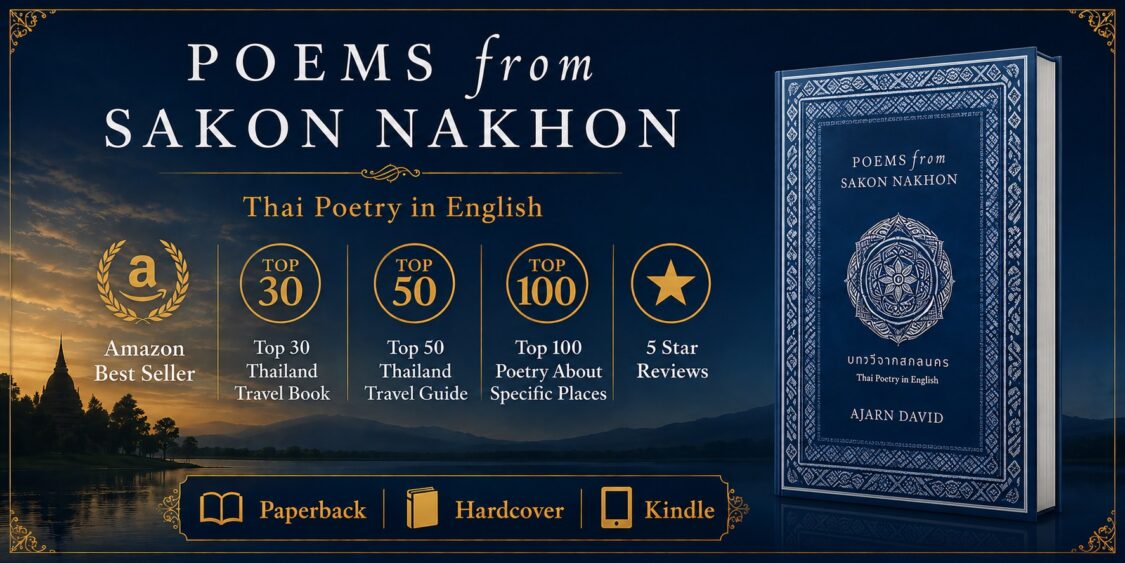
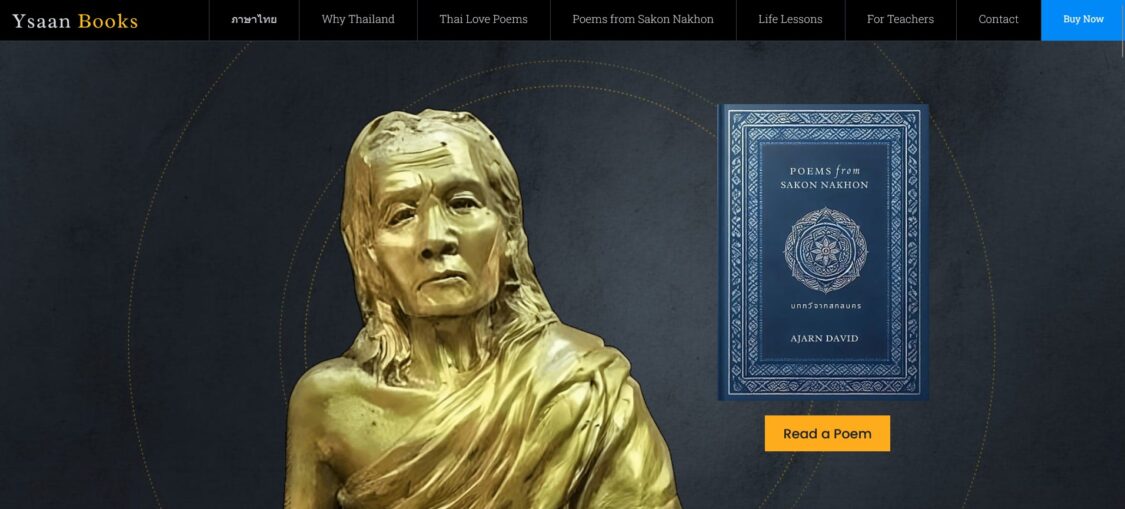
Which makes what happened on Amazon in 2025 genuinely strange. Poems from Sakon Nakhon, a bilingual poetry collection by Ajarn David, published by the small independent press Ysaan Books, climbed to No. 27 in Thailand Travel (being bought by readers in the U.S., Japan, Italy, Germany, Australia, Canada, England, India, and other countries). It wasn’t competing against other poetry books. It was competing against guidebooks to Phuket and Bangkok — and winning.
The Land That Tourism Forgot
Isaan, the northeastern plateau, covers roughly a third of Thailand’s landmass and is home to over twenty million people. That’s more than the population of the Netherlands. Its people speak Lao-inflected dialects, have ethnic and cultural ties to Laos that predate the modern border, and eat a cuisine so distinct from central Thai cooking that its signature dishes — sticky rice, som tam, larb — are now found on menus worldwide without most diners knowing where they came from.
None of this has translated into much coverage. Travel publishers go where the beaches are. Isaan, with its flat rice paddies, modest market towns, and ordinary daily life, has never been easy to package. The result is a region of vast cultural depth that remains almost invisible in international publishing.
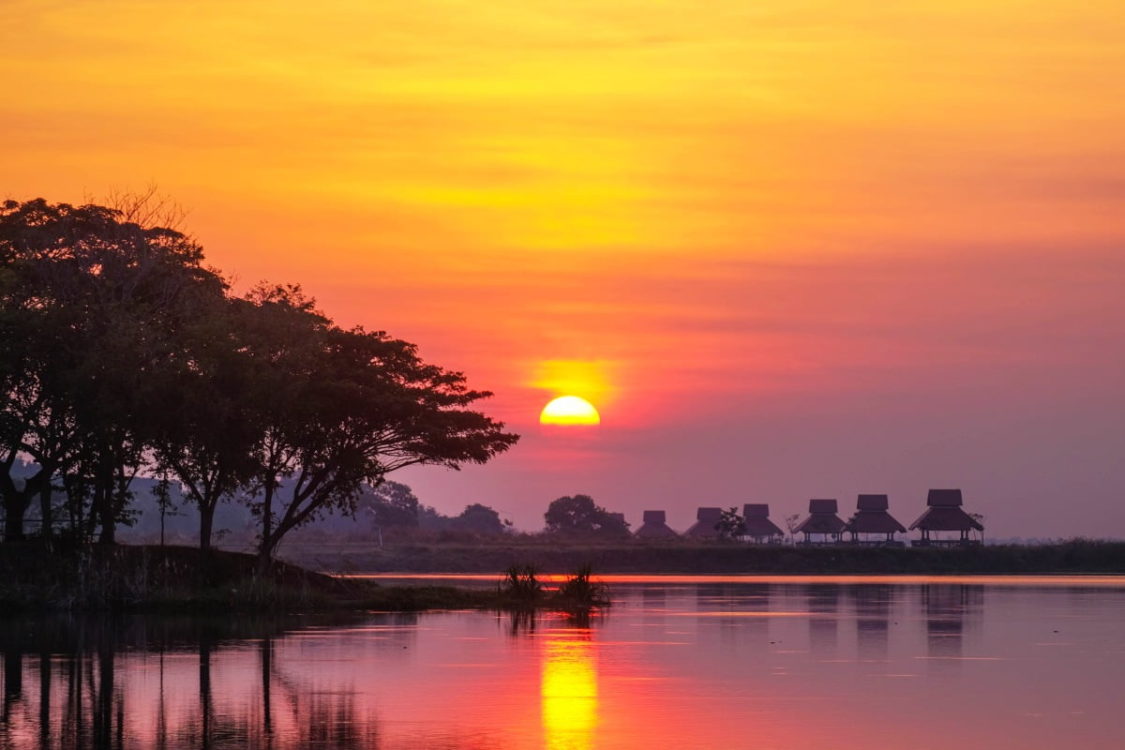
Sakon Nakhon sits at the edge of Nong Han, Thailand’s largest natural lake, ringed by forested hills. The province has been a centre of Theravada Buddhism for centuries and is especially associated with the forest monk tradition — a practice built around meditation, austere jungle living, and discipleship under great masters. Some of the most influential Thai Buddhist teachers of the last century came from this corner of the country, or were shaped by it. Their names are not well known outside Thailand. Inside it, they are revered.
The province is also one of the heartlands of natural indigo dyeing, a craft in which cloth is dipped repeatedly in fermented vats to produce the deep blue-black that has become a symbol of Isaan identity. Village weavers here still produce hand-loomed cotton and silk using techniques passed between generations of women. The collector’s edition of Poems from Sakon Nakhon is bound in that same indigo cloth, made by local artisans. That detail is not incidental.
The Poet’s Path Here
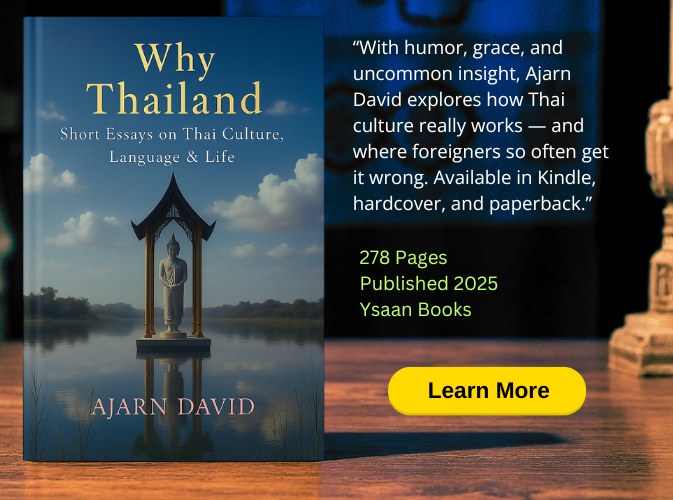
Ajarn David — ajarn is the Thai honorific for professor — has been an English lecturer at Thai universities for over twenty years. He is currently on faculty at Sakon Nakhon Rajabhat University. He did not arrive in Thailand directly. He went to graduate school in North Carolina, published his first two books of poetry there, then spent time in Europe teaching at the University of West Bohemia in the Czech Republic before eventually landing in the northeast of Thailand, where he stayed. Along the way he has written two books on learning the Thai language and a collection of short essays on Thai culture, language, and daily life titled Why Thailand.
That backstory matters because most English-language books about Thailand are written by people passing through. Journalists on short assignments. Backpackers turning a gap year into a memoir. Expatriates still in the first flush of culture shock. The literature of someone who has actually settled — who knows the landscape across twenty rainy seasons, who has students he has watched grow up — is a different thing.
The collection’s final poem makes this explicit. A fellow foreigner at a bar complains that no matter how many years you spend in Thailand, you’ll never be Thai. The poet agrees. And then says that’s not such a bad thing. It’s a quietly honest note to end on, and it’s characteristic of the book’s whole approach: clear-eyed about the poet’s position as an outsider, but written from somewhere well past the surface.
What’s Actually in the Poems
The book has 91 poems, and they range more widely than the title suggests. Readers expecting something scenic and meditative will find that, but they’ll also find dry comedy, Buddhist philosophy, romantic longing, local legend, and the occasional swipe at expat bar culture.
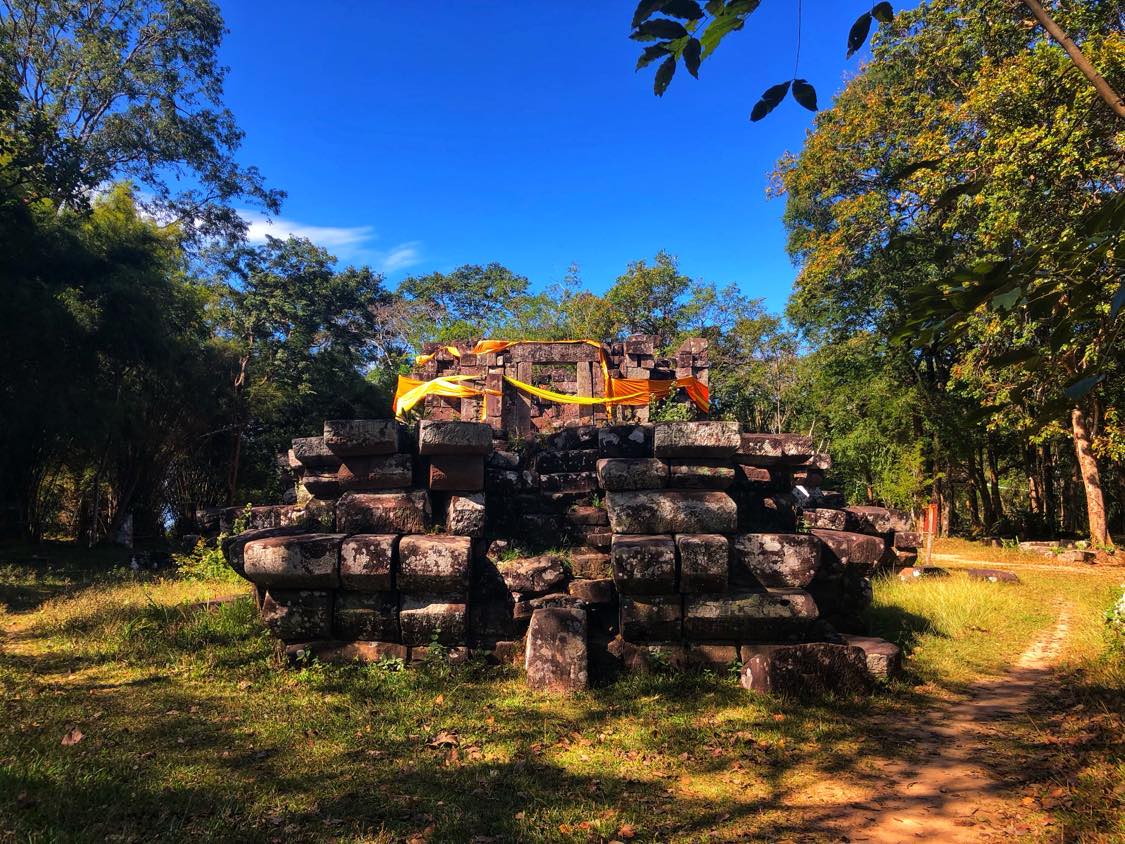
The seasons anchor the collection physically. The monsoon rains dominate the opening poem — waterfalls appearing in the mountains, fish turning up in flooded fields, farmers out tending sticky rice and cassava, temple drums audible in the distance. Each of the three Thai seasons gets its own poem. The landscape of Sakon Nakhon appears with real specificity: Phu Phek with its ancient Khmer ruins, the mountain paths of Phu Phan where barefoot monks pass villagers foraging mushrooms, the caves of Phu Pha Yon, the rice research station at Hawm Dawk Hung with its three hundred varieties.
But landscape is not the book’s main interest. Buddhism is. Not as atmosphere or exotic background — as a living set of ideas the poet has actually thought through. One poem takes the First Noble Truth, that life involves suffering, and finds in it something unexpectedly freeing. Another works through the Eightfold Path and arrives at patience as the quality that holds the rest together. A third uses the monks’ three-month rains retreat, Khao Phansa, to make an argument that interior withdrawal should be a daily practice for everyone, not an annual event. These are not a tourist’s observations. They are the poems of someone who has sat with these questions.
The forest monk lineage gets specific attention. Ajarn Mun — arguably the most influential figure in twentieth-century Thai Buddhism — appears in a poem recounting his final goodbye to the forests he called home for more than fifty years. Ajarn Wan Uttamo appears in a tense scene from 1970, walking alone through darkness while voices in the distance shout at him to stop. The book treats these figures with the kind of unsentimental care that comes from genuine familiarity with the tradition, not just knowledge of it.
There’s also a sustained thread of romance. Several poems take Thai emotional vocabulary as their starting point — ruk (love), ohk hahk (broken heart), mee sanay (enchantment) — and use the untranslatable weight of those words to explore what love feels and costs in a Thai cultural context. Nong Han lake, the great body of water at Sakon Nakhon’s edge, gets its own poem tracing the local legend of how it formed: a love story that went wrong and became geography.
Then there is the humor, which the book’s reviews tend not to mention but which is one of its real strengths. A poem about a late-night noodle seller serving bowls of warmth to the single and lonely, who set down their chopsticks to post “Sot!” — “Single!” — to their Facebook friends. A poem noting that seriousness is a virtue in the West and an offense in Thailand. An ode to the durian that doubles as an ode to love and hate. Without this, the collection would be earnest in a way that would ultimately work against it.
The Bilingual Design
Each poem appears in English and Thai, with romanized transliteration included alongside the Thai script. Ajarn David frames the transliterations explicitly as a tool for Thai language students, while noting that learning to read the script itself is the real goal.
This is an unusual format and it serves multiple audiences simultaneously. Students of Thai get a phonetic bridge into a tonal language with a script that takes most Westerners months to learn. Thai readers get access to the English originals’ sound and rhythm alongside the meaning. Expats, heritage readers, travelers curious about the culture — all find something here that a monolingual collection wouldn’t offer.
The reviewers who’ve responded most warmly tend not to be poetry readers in the conventional sense. One called the book “a perfect blend of cultural insight and lyrical beauty.” Another described it as “a heartfelt journey into the soul of Thailand.” That’s travel writing language, which is part of the point.
Why a Poetry Book Is Beating Thai Guidebooks
The conventional travel guide is in trouble. Not because people have stopped traveling, but because the practical information guides used to provide — where to stay, what to eat, how to get there — is now online, free, and updated constantly. What a book can still do better than any website is give you a way of seeing a place. A sensibility. A reason to care about somewhere before you arrive, or a means of understanding it after you’ve left.
Poetry turns out to be well suited to this. A good poem compresses what a prose writer might need several pages to approximate — a season, a mood, a cultural observation, a philosophical idea — into something short enough to read twice. The risk is always accessibility, the sense that poetry is a closed room. But a collection grounded in specific places and specific ideas, and one that doesn’t take itself too seriously, tends to stay open.
There is an irony worth noting here. Ajarn David has himself written about Thailand in essay and prose form — his book Why Thailand covers Thai culture, language, and daily life in exactly the kind of accessible, non-fiction register that conventional publishers favor. He knows how to write a guidebook-adjacent book. He chose poetry for this subject instead. That choice, and the fact that the poetry is now outselling the guides, says something about what readers are actually looking for.
Poems from Sakon Nakhon has found its readers at precisely this intersection: people who want more from Thailand than a beach ranking and less than an academic ethnography.
The Publisher Filling a Genuine Gap
Ysaan Books is a small independent press based in Sakon Nakhon with a clear mission: bilingual English-Thai publications about life and culture in Northeast Thailand. It is working in a space that larger publishers have entirely ignored.
For a region of twenty million people with a rich musical tradition, a distinctive craft heritage, a deep Buddhist history, and its own literary culture in the Thai language, Isaan has almost no footprint in English-language publishing. The odd academic monograph, the occasional chapter in a broader Thailand book. That is essentially it.
The success of Poems from Sakon Nakhon on Amazon’s travel charts is at least partial evidence that the gap is real and that readers will fill it when given the chance. Whether that translates into a wider publishing effort is another question. But the proof of concept is there.
What It Actually Offers a Reader
The book will not tell you where to eat in Sakon Nakhon. What it will do is give you the concept of greng-jai — having a heart in awe of others’ unspoken burdens — in a form that sticks. It will give you the forest monks and the indigo dyers and the legend of the lake. It will give you the rainy season and the cool season and the merciless heat. It will give you a poet who has spent twenty years in this place and is still curious about it.
That’s worth more to some travelers than a star rating. Thailand’s northeast has a literature in Thai. In English, it is only just beginning.
Poems from Sakon Nakhon is available in paperback, hardcover, and Kindle editions on Amazon, with a collector’s indigo cloth edition available in Thailand on Lazada and Shopee.
Read about Ajarn David’s follow-up book of bi-lingual Thai poetry: Under the Weeping Fig. And “Kit “Teung Teu” his new bilingual Thai love song in English.