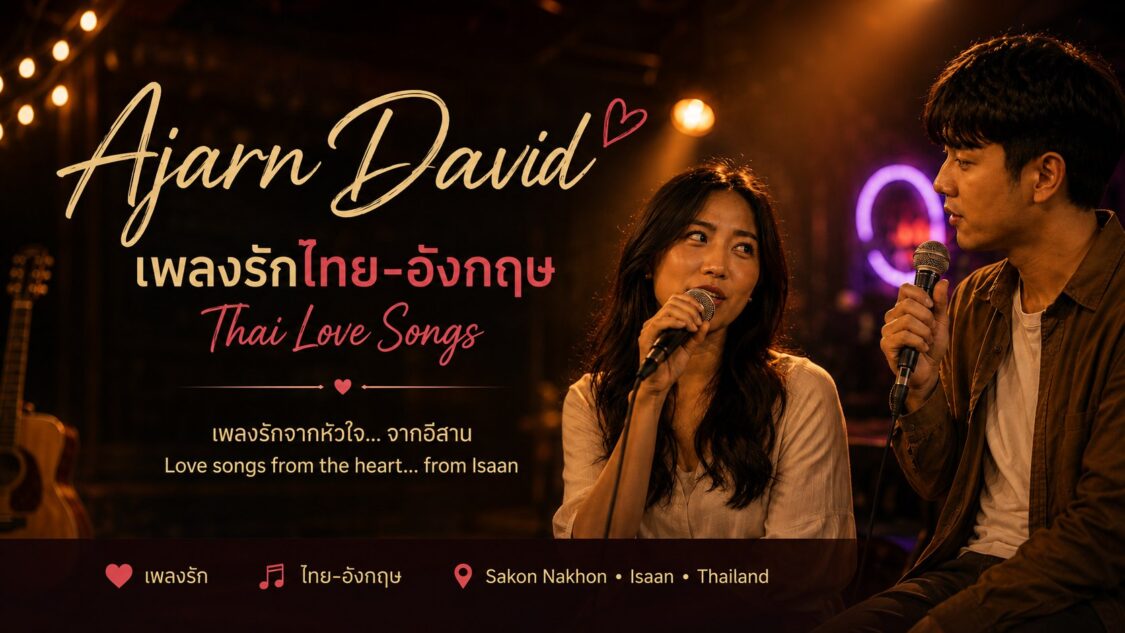
I wrote my Thai-English songs with two questions in mind: Could Thais enjoy singing them even if they had limited English skills? And could foreigners sing them even if they didn’t know Thai?
Admiring a song and feeling able to join in are two different things. Plenty of foreigners who love Thailand would like to sing in Thai, but familiar Thai songs often have fast verses, subtle tones, connected phrases, or wordplay that gets difficult at musical speed.
Thai singers run into the mirror version of this with English songs: reduced sounds, unfamiliar vocabulary, and rapid phrasing that make a line much harder to sing than to read.
I wanted to build a meeting place between those two audiences. The English verses had to stay clear and manageable for Thai singers. The Thai choruses had to be short, catchy, and realistic for foreigners to actually learn. Above all, the songs had to feel like something people would sing in a live music bar, at a party, at home, or with friends — songs, not language exercises set to music.
That idea also serves a larger goal I have. I want to help the Thai language reach a wider audience. Someone who’s never taken a Thai lesson may still be willing to sing a memorable Thai chorus. Once people form the words themselves and feel how they move with a melody, Thai stops being something they only hear from the outside. They’re in it.
I’ve now made karaoke videos for all five of my bilingual Thai love songs: “Rak Sakon Nakhon” (รักสกลนคร), “Kit Teung Teu” (คิดถึงเธอ), “Mai Rak Mae Kha” (ไม่รักแม่ค้า), and the male acoustic and female piano versions of “Mai Rak Lai Jai” (ไม่รัก หลายใจ).
Each recording has two karaoke versions: one with guided vocals and one with no lead vocal at all. People can start with the first Thai song and move to the second when their ready to sing without a guide.
When I started writing these songs, I had three things in mind.
Every song needed a chorus people could remember after hearing it only a few times. If friends are singing together, nobody wants to study a page of lyrics before joining in. A good group chorus pulls people in almost immediately.
The Thai had to be manageable for foreigners, and repetition alone wasn’t going to be enough. The phrases needed to be short, clearly spaced, and comfortable to place inside the melody. The goal was to give newcomers a chorus they could begin singing after only a few listens, then pronounce more naturally as they became familiar with it.
The English verses had to work in the opposite direction: familiar vocabulary, compact lines, rhyme, and recurring sentence patterns, so Thai singers could follow the story and remember what came next without translating in their heads.
None of this means stripping out every unfamiliar word or idea. A song can be accessible without being childish. What matters is giving singers enough support from melody, rhythm, rhyme, context, and repetition that one new word doesn’t derail the performance.
Some of Thailand’s best-known songs have unforgettable choruses, but the full performances can still be daunting for a foreign singer.
Take “Ma Thammai” (มาทำไม) by Bird Thongchai and Jintara Poonlarp. A foreign listener may pick up ma thammai, mai rak ko mai tong ma—roughly, “Why did you come? If you don’t love me, you didn’t have to come”—within a few listens.
But the song is also full of quick male-and-female exchanges, playful comebacks, tightly packed phrases, and a mix of Thai and Isaan. Knowing the hook does not necessarily prepare you for the rest of the song.
“Koo Kat” (คู่กัด), another Bird Thongchai favorite, presents a different challenge. Its humor runs on rapid-fire wordplay and contrasting pairs. That is exactly what makes it fun, and what can make whole sections feel like tongue-twisters set to music for someone who is not fluent in Thai.
A slow melody doesn’t save you either. “Lao Su Kan Fang” (เล่าสู่กันฟัง), also by Bird Thongchai (who you can tell is one of my favorite Thai singers) sounds gentle and unhurried, but the verses carry long connected thoughts. You’re managing breath, vowel length, tone, and natural Thai phrasing while trying to stay with the melody. Slow isn’t the same as easy.
These are great songs. They just assume you’re already comfortable in Thai. Mine take a narrower path into the language: the English verses carry most of the story, and a small set of Thai phrases carries the emotional weight. Foreign singers can learn the chorus first and get a little better at it every time it comes back around.
Pronunciation is only half the battle. Memory does the rest. When a karaoke signer has to read every word off a screen, their always a half-second behind, with their attention stuck on the next line instead of the melody or the people singing next to them. Once the words settle into memory, the whole thing loosens up and gets more fun.
That’s why the choruses of my Thai songs lean on a limited vocabulary and keep returning to the same rhythmic shapes. The English verses build in their own memory hooks. “Rak Sakon Nakhon” strings one “Let’s…” invitation after another. “Mai Rak Lai Jai” chains together end, mend, pretend, and again. “Mai Rak Mae Kha” sticks to one story—the same noodle shop, the same lunchtime visit, the same comic denial—so nothing new has to be tracked.
The same approach helps foreigners hold on to the Thai. Instead of long verses, they get anchor phrases: kit teung teu (คิดถึงเธอ), “I miss you”; mai rak… lai jai (ไม่รัก… หลายใจ), rejecting an unfaithful lover; and rak Sakon (รักสกล), “I love Sakon.” These phrases aren’t just pronounceable. They’re built to stick.
The guided-vocal version of my Thai karaoke song videos keeps a quiet vocal track underneath the instrumental. It shows you where a line starts, how long a word is held, and how the Thai and English sit inside the rhythm. Lose your place, and the voice finds it for you.
The no-vocal version drops the lead singer entirely. It’s for people who already know the song, want to put their own stamp on it, or are singing as a group.
Even if you already speak some Thai or English, start with the guided vocals. Move to the no-vocal track once you can enter every verse and chorus without waiting for the singer to lead you in.
“Rak Sakon Nakhon” (รักสกลนคร) is probably the easiest of the five to split among a group. It was written as a male-female duet, but friends can trade off lines or simply sing the whole thing together.
The verses follow a pattern:
Let’s ride through the Mountains of Phu Phan
Let’s go shopping for pha si khram
Let’s sit by the waters of Nong Han
Let’s go home to mueang sam tham
Starting every line with “Let’s” gives Thai singers a structure they can rely on. They already know how the next invitation begins, so they can focus on rhythm and place names instead of guessing at grammar.
The chorus turns the journey into a homecoming:
สกลนคร ใกล้ถึงบ้าน
คิดถึงจัง ชีวิตชาวบ้าน
รักอีสาน ทุ่งนาสวยงาม
รักสกล ใกล้ถึงบ้าน
Sakon Nakhon, glai teung baan
Kit teung jang, cheewit chao-baan
Rak Isaan, thung-na suay-ngaam
Rak Sakon, glai teung baan
Glai teung ban (ใกล้ถึงบ้าน), “almost home,” appears in the first and final lines, giving foreign singers a familiar landing point when the chorus comes around again. The echoing sounds in baan, chao-baan, and suay-ngaam help hold the four lines together.
The song moves through Sakon Nakhon in quick invitations rather than long descriptions: Phu Phan, indigo cloth, Nong Han, Phra That Phu Phek, Wat Tham Kham, Ban Tha Rae, Phon Yang Kham beef, and som tam by the pond. If you’ve been to Sakon Nakhon or Isaan, singing it brings the trip back. If you haven’t, it’s a musical introduction.
If you’re singing Thai for the first time, start here. 👇
The song is a back-and-forth between a man and a woman who both can’t quite say what they feel. The English verses keep it short and direct:
Why do you make it so hard for me
To say the things I want us to be,
You love your English, it’s oh, so cool,
But when I try, I sound like a fool.
The chorus barely moves off one phrase:
คิดถึงเธอ
คิดถึงเธอ คิดถึงเธอ
รู้ไหมว่า
คิดถึงเธอ
Kit teung teu
Kit teung teu, kit teung teu
Roo mai wa
Kit teung teu
Kit teung teu (คิดถึงเธอ) means “I miss you” or “I’m thinking of you.” The only other phrase is roo mai wa (รู้ไหมว่า), “Do you know that?”
Because it circles back to the same phrase so often, people can start singing before the song is even finished. Split the group: one or two on the English dialogue, everyone else answering with the Thai chorus. The repetition isn’t padding. It’s two people stuck circling the same feeling, unable to say it outright.
The song “Mai Rak Lai Jai” (ไม่รัก หลายใจ) comes in two arrangements: acoustic, sung by a man, and piano, sung by a woman. The lyrics are the same, but the emotional weight shifts with the singer.
The acoustic version leaves the words exposed:
This is the end,
there’s nothing left for us to mend,
nothing left now to pretend.
Don’t try again.
“Mend” and “pretend” might be new words for some English learners, but the rhyme carries them. The short lines leave room to land each thought.
The Thai chorus doesn’t hedge:
ไม่รัก… หลายใจ
จบวันนี้
ไม่รัก… หลายใจ
ไปซะที
Mai rak… lai jai
Jop wan-nee
Mai rak… lai jai
Pai sa-tee
Mai rak… lai jai (ไม่รัก… หลายใจ) refuses an unfaithful heart; jop wan-nee (จบวันนี้) means “it ends today”; and pai sa-tee (ไปซะที) means “just go.” The pause built into the title phrase gives a new singer a beat to form the words.
The lyrics and melody remain the same, but the piano arrangement and Thai female voice change the shade of the song’s heartbreak. There is more space around the words and a different kind of hurt in them.
Pick whichever version suits your voice or mood. Or sing both. Hearing a man and woman perform the same lyrics shows how differently the words can land depending on who is singing them.
This is the comic one. A female singer tells the story of a man who shows up at the same noodle shop every day, insisting that he loves the noodles, not the woman selling them.
Every day he’d sit alone at her shop
at her shop near the bus stop.
His friends would laugh and say “tok lum rak”
that he’d fallen in love and couldn’t get up.
Tok lum rak (ตกหลุมรัก) is the Thai expression for falling in love — literally, falling into a “love hole.” The next line runs with the image: he can’t get back up.
The Thai chorus is one long denial:
ไม่รักแม่ค้า
รักบะหมี่หมูแดง
รักบะหมี่หมูกรอบ
แต่ไม่รักแม่ค้า
ไม่รักจริงๆ
Mai rak mae kha
Rak bamee moo daeng
Rak bamee moo grawp
Tae mai rak mae kha
Mai rak jing jing
He doesn’t love the shopkeeper. He loves the red pork noodles and the crispy pork noodles. The food names make this one a step up from “Kit Teung Teu,” but the grammar repeats and the denial keeps circling back, so it’s never far out of reach.
After the shop closes, mai rak mae kha (ไม่รักแม่ค้า), “I don’t love the shopkeeper,” flips to rak mak mae kha (รักมากแม่ค้า), “I love the shopkeeper very much.” That’s the joke: he finally admits what everyone already knew.
There’s a reason beyond entertainment for keeping these choruses simple.
People often meet a language through music before they meet it any other way. They don’t need to understand every word. They learn the sound of a phrase, its rhythm, and the emotion tied to it. A chorus can outlive a vocabulary list.
When someone on the other side of the world sings kit teung teu, mai rak lai jai, or rak Sakon, the language has traveled with the song. They might not be able to hold a conversation in Thai. But for those few lines, Thai isn’t distant. It’s something felt in the voice and shared with whoever is singing next to them.
That is how I hope to help Thai reach a wider international audience: not by handing newcomers something difficult on their first day, but by giving them an enjoyable first step. If singing a chorus makes the language feel familiar, perhaps it will also make someone curious enough to go further — into the country, its people, and the culture the words came from.
It runs both ways. Thai singers get English verses they can hold on to through story, rhyme, and repetition. Neither language is decoration here. The song needs both.
New to Thai? Start with “Kit Teung Teu.” The chorus repeats often enough that you’ll get more comfortable with every pass.
Singing with a group? Try “Rak Sakon Nakhon.” The “Let’s…” lines split easily between people, and the chorus feels like a shared homecoming.
Want a breakup song? Pick the acoustic or piano version of “Mai Rak Lai Jai” based on your range. Learn one and you already know the other.
Feeling playful? Choose “Mai Rak Mae Kha.” The noodle-shop story gives you room to act it out.
Start each song with the guided-vocal track. Switch to the no-vocal version once you no longer need the singer to show you where each line starts.
I didn’t write these songs only to be heard. I wrote them to be sung — by Thais and foreigners, alone, as duets, or with groups of friends.
Choose a song, invite someone to join you, and sing.