Thai Songs Sung in English – Best of Playlist
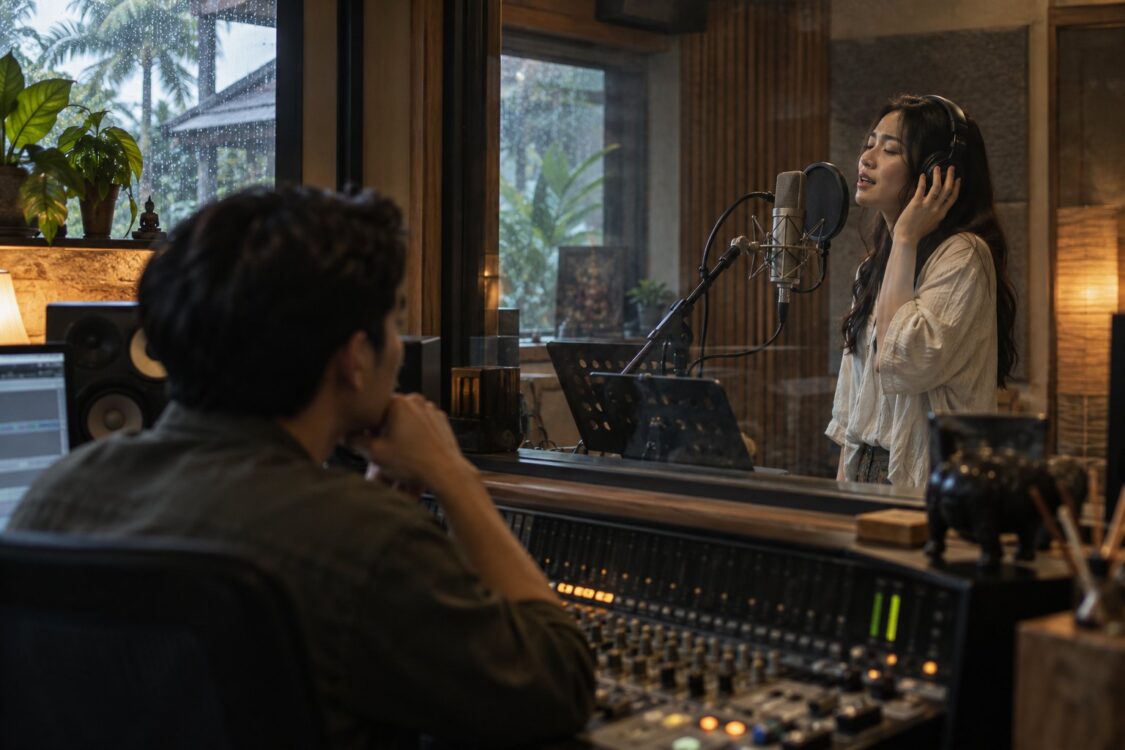
Many Thai artists also record in English. Some write whole albums in English from the start. Others take a song that already exists in Thai and record an English version of it, or let both languages sit in the same track. If you’re curious about Thai music but don’t speak Thai yet, any of these approaches works as a way in.
The playlist below pulls all of them together — Phum Viphurit’s laid-back indie pop, HYBS’s easy grooves, Tilly Birds’ heavier rock, TaitosmitH’s bilingual storytelling, Ajarn David’s Thai-English love songs. There’s no single sound tying it together: Thai songs sung in English cut across genres rather than sitting in one lane.
Listen to the Thai Songs Sung in English Playlist
You’ll find three different things mixed into this Spotify playlist: English-language recordings by Thai artists, tracks that use both English and Thai, and English versions of songs that also exist in Thai. A title in English doesn’t always tell you which of these you’re getting, so it’s worth keeping that in mind as you listen.
Phum Viphurit: English Lyrics, a Thai Point of View
If you’re looking for Thai artists who sing in English, start with Phum Viphurit. His songs land easily on ears used to indie pop, but they never lose their own sense of humor or sense of place. Four of his tracks made the playlist — “Greng Jai Please,” “Temple Fair,” “Lover Boy” and “Long Gone” — so there’s more than one side of him to hear.
“Lover Boy” is the easiest entry point. The rhythm is unhurried, the vocal delivery light, and none of it requires prior context. “Temple Fair” points somewhere more specific — its English title conjures up a scene that’s a genuine part of Thai community life. “Greng Jai Please” goes a step further, dropping greng jai — a Thai concept roughly about not wanting to burden or inconvenience others — right next to an English word. Even the title shows how English can carry a distinctly Thai social idea.
Start with the official video for “Lover Boy”:
HYBS and the Softer Side of Thai Indie Pop
HYBS shows up three times here, with “Tip Toe,” “Dancing with my phone” and “Ride.” It’s a different mood from Phum’s songs — the vocals don’t fight the instrumentation, and the rhythms just carry you along. These are good driving songs, good background-for-a-quiet-afternoon songs, even if a closer listen reveals more craft than the easy surface lets on.
“Ride” is probably the best first listen. “Dancing with my phone” has a more playful title and mood to match, and “Tip Toe” adds another light, melodic moment to the mix. If one of these tracks pulls you in, the Thai indie music guide is a good next stop for artists beyond the biggest Thai pop names.
Violette Wautier, Numcha and English-Language Pop
Violette Wautier’s “Smoke” and Numcha’s “Keep Cold” make a nice pair for showing how differently two solo artists can approach English. “Smoke” pulls you into something close and intimate — the vocal alone does most of the work. “Keep Cold” takes a lighter route musically, with a melody that’s easy to come back to.
Neither song needs to be treated as some kind of English-language detour away from “real” Thai music. These are artists working within Thailand’s music scene, picking whichever language suits the record they’re making. Violette’s official “Smoke” video is worth watching for how that choice plays out visually, not just musically.
From there the playlist moves into more polished English-language pop: Tata Young’s “I Believe,” Jeff Satur’s “Ride or Die,” BRIGHT’s “Lost&Found” and Earth Patravee’s “Timehop (English Version).” Earth’s title spells out the choice for you — pick the English version if that’s what you’re after.
Tilly Birds: English Songs from a Thai Rock Band
Tilly Birds’ “White Pills” hits harder emotionally than most of the breezier indie tracks on this list. The band lets the English lyrics carry real weight without smoothing out the rock underneath them. It’s a good counterpoint to the assumption that Thai bands only reach for English when they’re chasing something soft and internationally palatable.
“Heaven,” a collaboration with the Filipino band Ben&Ben, pulls the playlist in yet another direction — musicians from two different Southeast Asian countries, recording together in English. It’s also a reminder that this playlist is best understood through its songs and artists rather than any hard rule that everyone on it has to be Thai. Tilly Birds anchor the track; Ben&Ben are the collaborators.
Here’s the official video for “White Pills,” which leans into the band’s heavier side:
When English and Thai Share the Same Song
Not everything on this playlist stays in English the whole way through. TaitosmitH’s “Hello Mama” opens with English lines, then shifts into a chorus sung to the singer’s mother in Isaan language. That switch changes how close the song feels — the English sets the scene, and the words to his mother make it personal.
If you’ve never heard Isaan language show up in a contemporary track, “Hello Mama” is worth the detour. It also shows why a playlist of Thai songs with English lyrics doesn’t need to rule out Thai entirely — sometimes moving between languages gives a song its punch. For more on the regional traditions behind tracks like this, the guide to Thai music genres fills in more of the background.
Ajarn David’s Thai-English Love Songs
Three tracks from Ajarn David’s Ysaan EP made the cut: “ไม่รัก หลายใจ (ฝั่งเขา)” (Mai Rak Lai Jai, male version), “คิดถึงเธอ” (Kit Teung Teu) and “ไม่รักแม่ค้า” (Mai Rak Mae Kha). An English-speaking listener might scroll right past titles like these, but English actually does a lot of the work in these songs.
“Kit Teung Teu” is a male-female duet, and its English verses lay out the misunderstandings between the two singers before the Thai chorus brings things back to one short phrase: คิดถึงเธอ — “I miss you.” That’s a deliberate contrast — the verses give each voice room to make its case, and the chorus gives them something to land on together. There’s more on the song’s backstory in Ajarn David’s piece on “Kit Teung Teu” as a Thai-English pop duet.
“Mai Rak Lai Jai” heads into breakup-song territory — the playlist has the male acoustic version, while a female piano version gives the same lyrics a different emotional reading. “Mai Rak Mae Kha” tells a smaller, more specific story built around a noodle shop. Put together, these tracks show that bilingual songwriting can do more than tack a Thai chorus onto an English song — the choice of language can actually shape who the characters are and where the story sits.
Ajarn David is American-born and has lived and worked in Thailand for more than two decades. He’s on this list because the playlist is interested in music made within Thailand and songs that bring English- and Thai-speaking listeners into the same room — not because he’s a Thai-born artist. His account of writing “Rak Sakon Nakhon” is a good look at how place shapes his songwriting more broadly.
More Sounds in the Playlist
A handful of other tracks round things out without fitting neatly into any of the categories above. YONLAPA’s “Let Me Go” brings an indie-band feel; Slot Machine’s “Give It All To You” is another way into English-language Thai rock. “The Only One” by Part Time Musicians and “Winter’s Love” by My Life As Ali Thomas slow things down between the brighter pop cuts.
There’s also “Thai Tea” by Benjamin Varney and Mintra A., “Bad Girls Like You – English Version” by Tobii and DOLLA, and the short “Moodeng Moodeng – English Version” by GMM SAUCE and PetaBear. Between all of these you get a sense of the full range covered here — full English recordings, officially labeled alternate versions, bilingual tracks and lighter novelty songs alike.
Want a wider introduction after working through this playlist? Discover Thai Music: A Beginner’s Guide is a good next stop. English-language songs make for a comfortable starting point, but Thai-language music opens up a lot more voices and styles once you’re ready for it.
What Counts as a Thai Song Sung in English?
No single rule covers everything on this list. Some songs are sung entirely in English by Thai artists — Phum Viphurit’s “Lover Boy,” Violette Wautier’s “Smoke.” Some are explicitly labeled English versions, like Earth Patravee’s “Timehop.” Others, like TaitosmitH’s “Hello Mama” and Ajarn David’s songs, mix both languages. And “Heaven” adds a collaboration with musicians from the Philippines.
That range gives listeners more than one place to start. For familiar English lyrics, there’s Phum, HYBS or Violette. For songs in which the move between languages shapes the story, there’s “Hello Mama” or “Kit Teung Teu.” Either way, the playlist lets listeners begin with what they can understand and follow the artists from there.