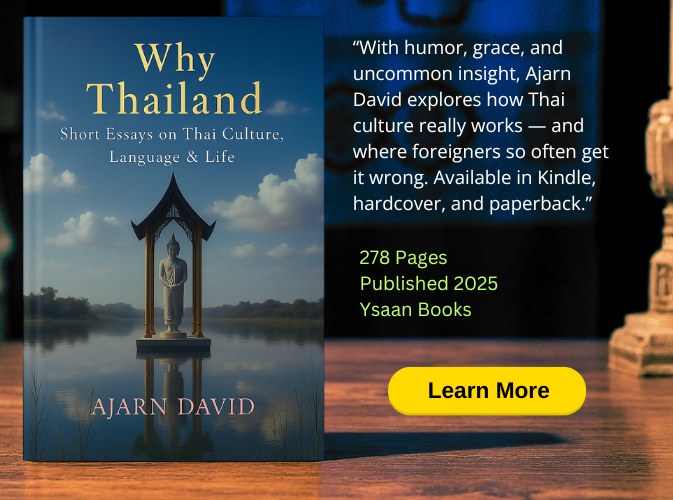
The Best Hidden Thailand Guidebook
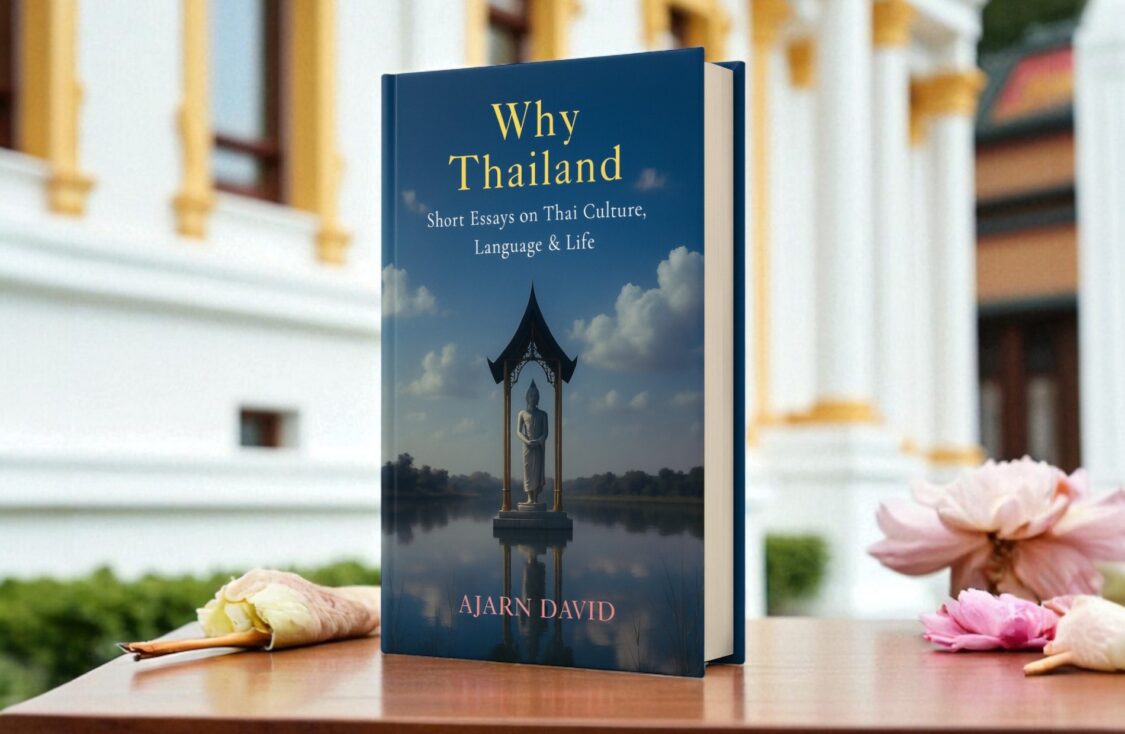
In an age when travel is mapped by algorithms and rated by stars, Why Thailand: Short Essays on Thai Culture, Language & Life (Ysaan Books, 2025) stands apart as a Thailand guidebook that begins not with sightseeing but with understanding.
Written by Ajarn David, a university lecturer who has spent more than two decades living and teaching in Thailand, this remarkable collection of seventy-five essays reveals what no itinerary can: the invisible logic of Thai life. It’s the Thai guidebook that explains not just what Thais do, but why they do it — and how those same values can help travelers experience the country with more grace, humor, and connection.
A Guidebook for Hidden Thailand
Every visitor notices Thailand’s smiles, but few realize that each one carries a message. In essays such as Thai Smiles and Their Meanings and The Way of Thai Listening, David decodes these subtle gestures as expressions of empathy, calm, and harmony. What Westerners mistake for formality is, in fact, emotional literacy — an instinctive way of keeping life gentle.
It’s here that this Thailand guidebook starts to transform from cultural commentary into something more like a manual for kindness. By teaching readers how to interpret silence, patience, and politeness, Why Thailand becomes a field guide to emotional intelligence. And while many travel writers describe temples or cuisine, Ajarn David’s writing goes further, showing how every smile, nod, or pause is part of a national conversation about peace. To read him is to hear that conversation clearly for the first time.

The Moral Grammar of Everyday Life
Many of the essays examine Thailand’s moral architecture: The Art of Being Greng Jai (เกรงใจ), Saving Face, A Culture of Respect, and Nam Jai: Water Heart. Together, they map a nation where self-restraint and generosity aren’t moral options — they’re social glue.
Through stories drawn from classrooms, temples, and markets, Ajarn David shows how these invisible rules sustain a society that prizes consideration over confrontation. For travelers accustomed to bluntness, this insight is revolutionary. The book turns the everyday — ordering food, greeting elders, sharing space — into moments of discovery. Each chapter feels like stepping into a private tutorial on human decency, with Thailand as the teacher.
The Spiritual Blueprint Beneath Modern Thailand
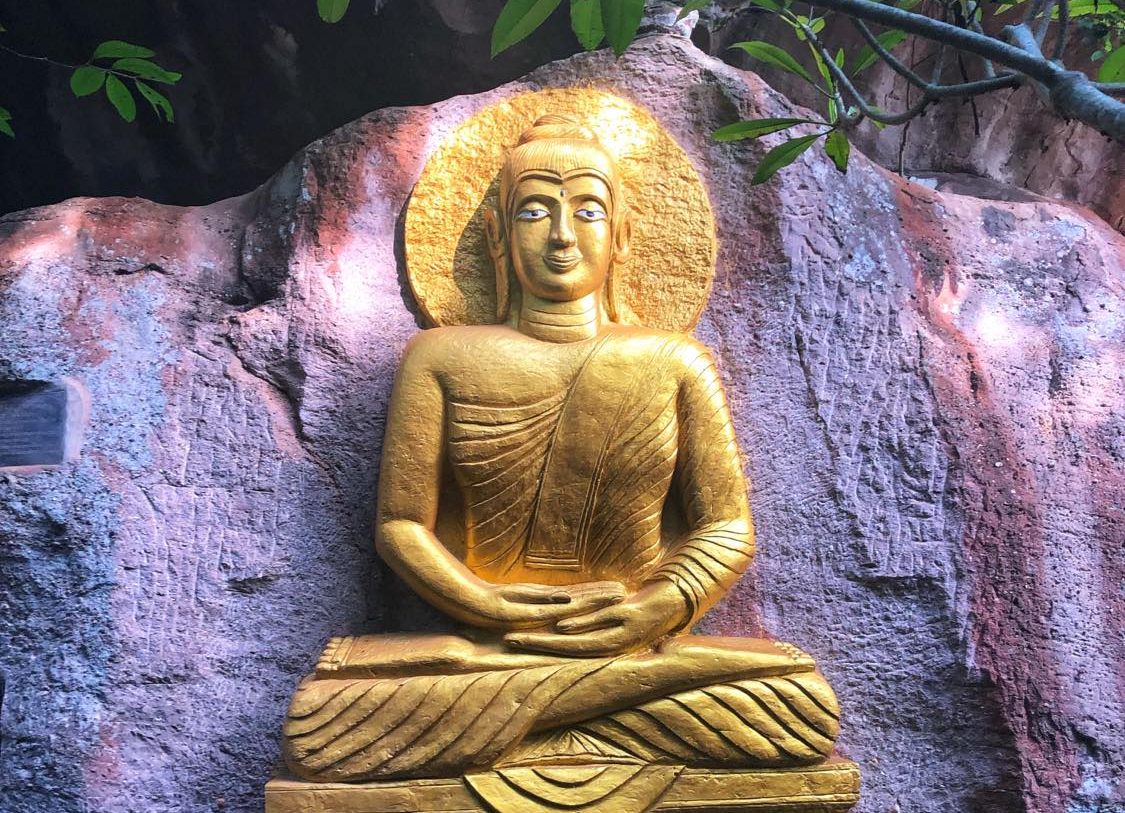
A large part of the guidebook explores the Buddhist worldview shaping Thai behavior. In The Eightfold Path for Tourists, The Hidden Dharma, and Visakha Bucha Day, Ajarn David writes not as a preacher but as an observer of living faith. He explains how Buddhism in Thailand isn’t confined to temples — it’s embedded in patience, humor, and moderation.
This is where the book feels almost meditative. Readers begin to sense that every polite gesture, every pause, is an echo of Buddhist balance. It’s a lesson that transforms how we interpret travel itself — from consumption to contemplation. By the time you finish these sections, you may realize that the stillness of a monk’s walk and the laughter of children at a festival spring from the same spiritual soil.
Family, Love, and Tradition
Some of the most memorable essays delve into Thai family and relationships: Thai Dowry Defended, The Prostration Debate, An Epic Thai Love Story, and The Mia Noi Question. Here, Ajarn David explores how gratitude and obligation intertwine in Thai life. Rather than judging from Western lenses, he explains the cultural logic of respect, debt, and affection.
The result is not sociology but storytelling — sharp, funny, and empathetic. Readers finish these sections realizing that Thai society isn’t mysterious at all; it’s built on principles that every culture once held dear: gratitude, humility, and care for others. These chapters also reveal something universal: that love and loyalty, in any culture, are languages learned over a lifetime.
The Everyday Philosophy of Sufficiency
Thailand’s national ethos — the Sufficiency Economy Philosophy championed by King Bhumibol the Great — runs quietly through essays such as Unraveling Thai Time, Sanuk Culture, and Cultural Soft Power. Ajarn David connects this ethic of “enoughness” to the rhythm of rural life, where contentment outweighs competition.
For travelers overwhelmed by constant motion, these reflections feel like an antidote. This Thai culture guidebook reminds us that to travel well is to live simply — to replace ambition with attention. It is, in a sense, a slow travel manifesto hidden inside a work of cultural analysis, urging us to find wealth not in accumulation but in appreciation.
Communicating & Traveling in Thailand
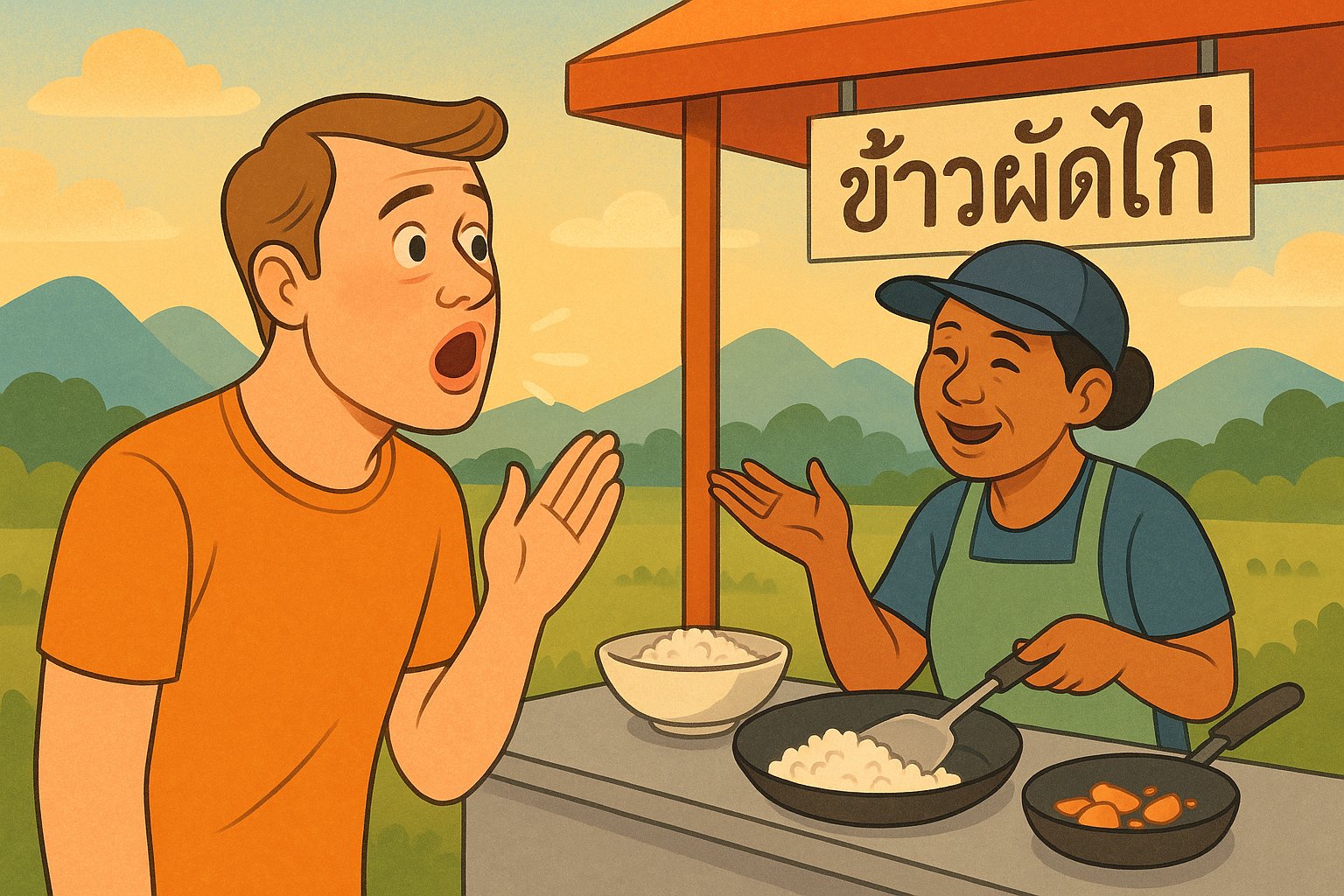
The later essays, including Foreigners Who Can Speak Thai, Is Thailand Dangerous?, and How Men vs. Women Speak Thai, address some common misunderstandings. Ajarn David handles these topics with warmth and candor, offering advice foreigners who wish to engage, not just observe.
He writes as a teacher who has made every mistake himself, and learned the humor in them. That humility is what gives Why Thailand its persuasive power. It’s not written about Thailand; it’s written with Thailand. The book becomes a dialogue between insider and outsider — a model for how curiosity, when paired with respect, can evolve into genuine friendship.
Why You’ll Keep This Thai Guidebook
By the end, readers realize that this is not a book to finish; it’s a book to revisit. Its seventy-five essays form a living curriculum for anyone drawn to Thailand’s gentle confidence. It can be read as preparation for a trip, reflection afterward, or quiet guidance during a long stay.
Each essay stands alone, yet together they compose something rare — a Thailand guidebook for the soul. Ajarn David’s words stay with you the way Thailand itself does: softly, persistently, and with unexpected wisdom.
For travelers who want more than a checklist, and for longtime residents who still wonder what makes the Thai heart tick, Why Thailand: Short Essays on Thai Culture, Language, and Life is the book to own.
Now available from Ysaan Books (2025) in hardcover, paperback, and Kindle on Amazon. Part of Ajarn David’s Thai Way Series, which also included the bilingual (English/Thai) Poems from Sakon Nakhon: Thai Poetry in English, and Life Lessons from Isaan, Thailand, originally written in Thai.
Learn more at: Thai Way Series.