What Remains: A Thai Life Lesson
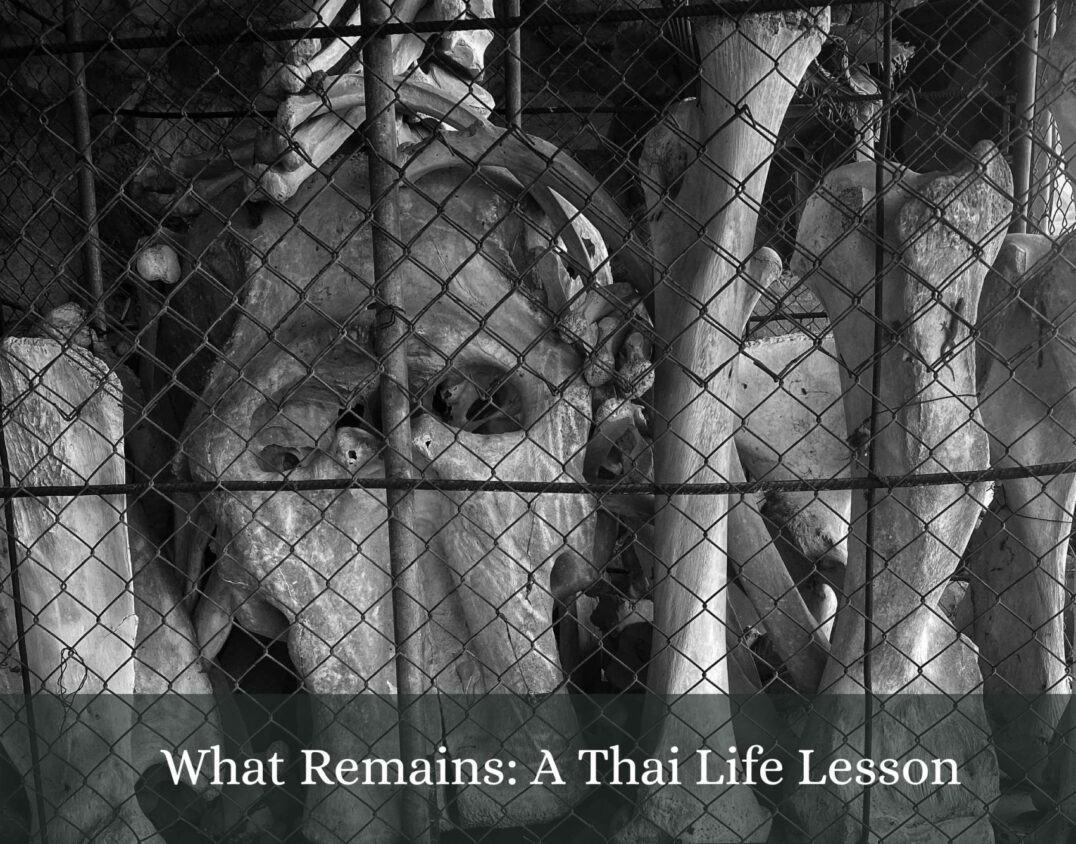
While walking the grounds of the temple of the Reclining Buddha Cave, Wat Tham Phra Phuttha Saiyat (วัดถ้ำพระพุทธไสยาสน์), I came across the bones of an elephant who had pulled heavy timber to build the temple’s old Viharn. The bones were stored in a cage, as a memorial to the great elephant, with a sign that read:
อันวัวควาย ตายเล่า เหลือเขาหนัง
ช้างตายยัง เหลืองา เป็นสักขี
ส่วนคนตาย เหลือไว้ แต่ชั่วดี
บรรดามี ประดับไว้ ในโลกาฯ
When cattle and buffalo die, they leave behind horns and hides.
When an elephant dies, it leaves its tusks as a witness.
But when a human dies, they leave only their good and bad deeds,
Their virtues adorn the world.
This short stanza of Thai poetry, passed down for generations, is one of those Thai life lessons that seems almost too simple at first glance. Yet the more you sit with it, the more it unfolds.
The poet compares the death of animals with the death of human beings. Buffalo leave horns and hides, elephants leave ivory. Humans, however, leave only their deeds. What matters is not possessions, not wealth, not status — but the mark of good or evil they leave upon others.
It’s a verse still quoted today in Thailand. It sometimes comes up at Thai funerals, where monks remind the living that the only inheritance that truly matters is the one carried in memory and moral example.
Why Goodness Is Called an “Adornment”
Notice how the stanza names both the good (dii ดี) and the bad (chua ชั่ว). Both remain after we are gone. But the final line pivots. It says only that our virtues adorn the world. Why is that?
In Thai culture, deeply shaped by Buddhism, bad deeds are acknowledged but remain as stains or weights after we have gone. They drag down others rather than lift them up.
Goodness, on the other hand, is remembered in a way that beautifies the lives of others, like fresh flowers at a spirit house or gold leaf on a Buddha image.
The word ประดับ (prà-dàp) means to decorate, to set in place, to make beautiful. In temples, it’s the act of adorning Buddha statues with offerings. In Thai family life, it might mean adorning a home with symbols of respect and care. So when the verse says virtue “adorns the world,” it means that goodness beautifies not just memory but the very social fabric Thai people live in.
Buddhism teaches that karma follows us beyond this life. But it also teaches that our actions ripple outward in ways that affect others long after we are gone. Our virtue inspires others to act well; our cruelty discourages trust and harmony. So the verse is not only about what happens to us after death, but about what remains in the world of the living.
Read the Full and Newly Edited Version of This Essay
in Why Thailand: Short Essays on Thai Culture, Language, and Life
BUY ON AMAZON BUY IN THAILAND

- How I Wrote “Rak Sakon Nakhon”: A Thai Song for the Road Home - September 12, 2026
- Easy Thai Songs to Sing & Learn for Karaoke - September 5, 2026
- Reframe Your Brain for Thai Learning - April 18, 2026