Pha Suksan: Thailand’s Hidden Quarry Turned Nature Retreat
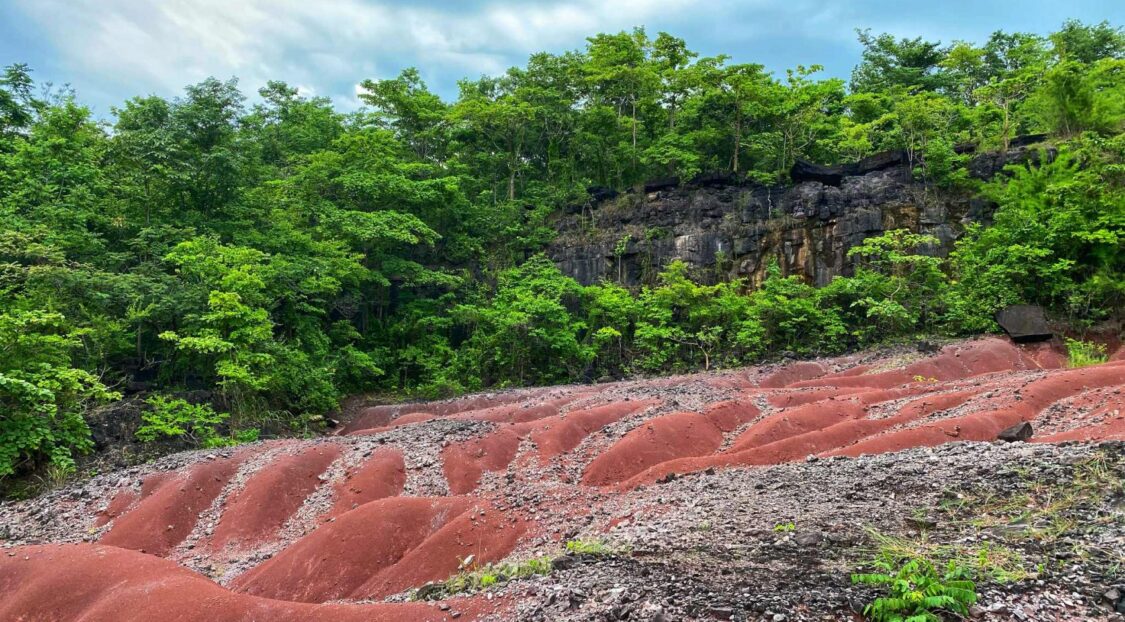
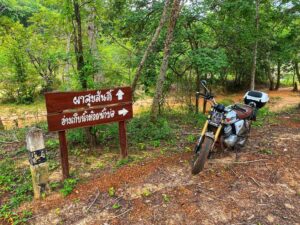
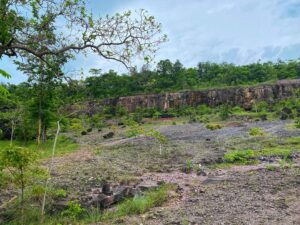
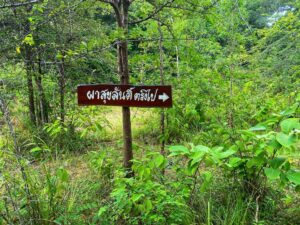
Just outside Ban Pracha Suksan (บ้านประชาสุขสันต์) in northeastern Thailand lies a landscape few travelers know — a hidden nature retreat that was once a working quarry. Pha Suksan Cliff (ผาสุขสันติ์) is one of Sakon Nakhon’s many hidden attractions that truly are off the beaten track, a place where you’ll rarely run into tourists.
This old quarry is known only to local residents, who visit the area to wonder at its dramatic forms and subtle beauty. Even most these visitors are unaware of the history of the quarry and its story of extraction, abandonment, and community renewal.
From Thai Quarry to Quiet Nature Retreat
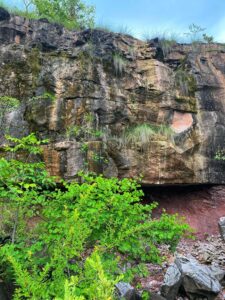
In the late 1960s and early 1970s, as Thailand expanded its road network across the Northeast, contractors blasted into a sandstone hill near Ban Pracha Suksan to harvest stone for the Sakon Nakhon–Udon Thani highway. The site functioned as a temporary quarry, yielding vital raw material for infrastructure that would connect rural communities across Isaan.
Once the road was completed, the quarry was abandoned. For decades, the exposed cliff face, fractured stone, and gaping cuts remained untouched — a forgotten byproduct of Northeast Thailand’s progress.
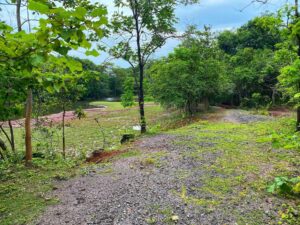
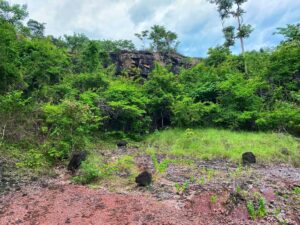
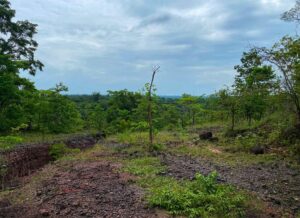
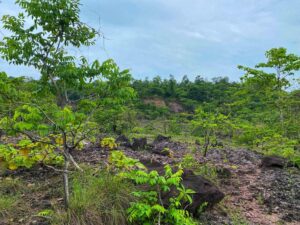
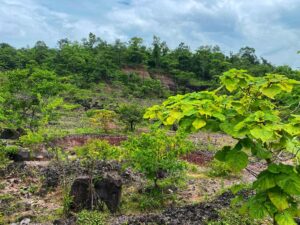
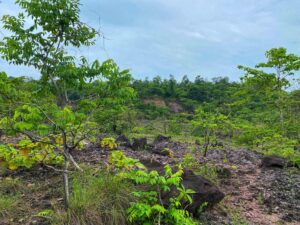
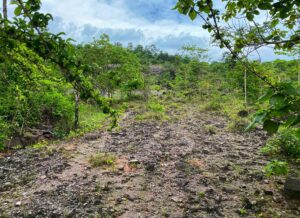
But over time, nature returned. Wild grasses grew between cracks. Trees took root in broken ledges. Rain and wind smoothed the raw surfaces. What was once a symbol of extraction quietly became something else: a natural overlook with panoramic views and unexpected tranquility. Villagers began to see the area not as a scar, but as a hidden retreat waiting to be appreciated.
They gave it a name to match that shift: Pha Suksan (Suksan Cliff), aligning it with the village’s identity and reestablishing the site as a place of reflection, not removal.
A Landscape That Tells Two Stories
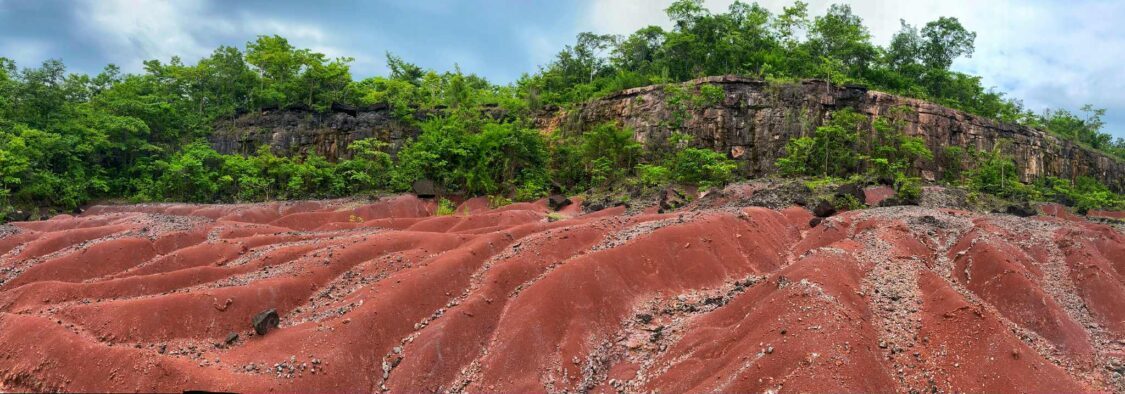
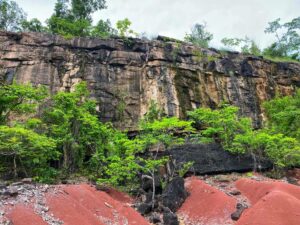
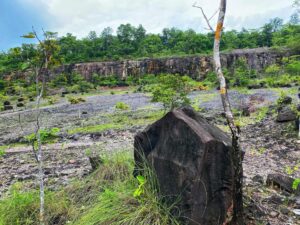
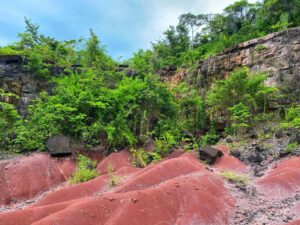
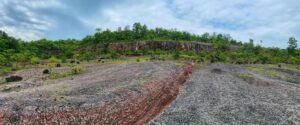
Today, visitors to Pha Suksan encounter more than just a viewpoint — they walk into a layered story. The cliffside reveals sharp angles left by quarrying, but these are now softened by vines, lichen, and seasonal blooms. When the sun sets, the rock face glows in warm light, creating a landscape that feels both rugged and serene.
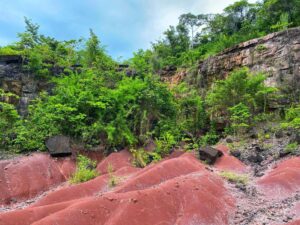
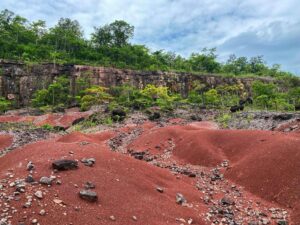
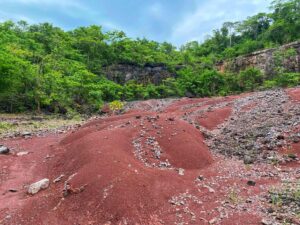
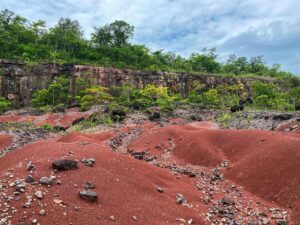
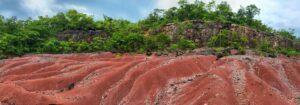
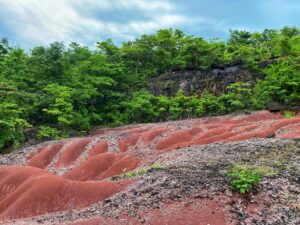
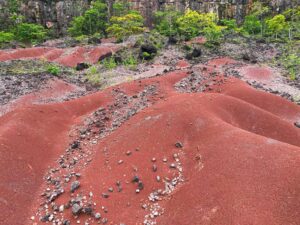
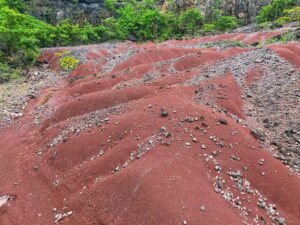
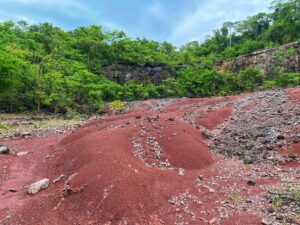
The ground beneath is especially striking. Rich in laterite soil, the quarry floor glows with a deep, rusty red — the result of iron oxidation common in tropical regions like Isaan. Years of rain and runoff have sculpted the earth into smooth, undulating mounds and small gullies, resembling a miniature badlands.
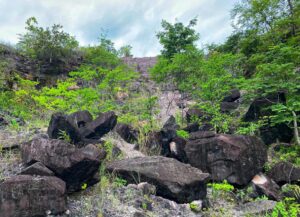
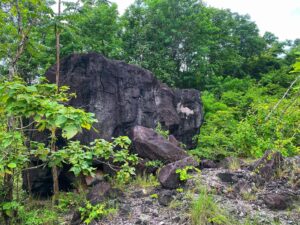
Scattered across the red soil are remnants of the past: volcanic boulders once harvested for road construction, now sitting like natural sculptures amid the rewilding terrain. It’s a rare chance to see geological recovery in action — a quiet transformation shaped by time.
Some boulders appear sculptural, evoking animals or mythical figures — not through carving, but through the randomness of broken stone and the eye of the beholder. It is this interplay between natural beauty and human history that makes Pha Suksan a truly distinct nature retreat in Thailand.
A Thai Village That Reclaims the Land
Pha Suksan’s transformation mirrors the journey of Ban Pracha Suksan (บ้านประชาสุขสันต์), a village founded in the 1960s that grew from a small rural settlement into a peaceful, award-winning community.
In recent years, the village chose to honor a humble creature long seen in local fields — the yae (แย้), a small ground-dwelling lizard — by erecting a statue known as Paya Yae (พญาแญ้) at the village school.
Celebrated for coexisting with children at play and thriving alongside community life, the lizard has become a symbol of identity, humility, and resilience — values reflected not only in the new landmark but also in the spirit that reimagined the once-forgotten quarry as Pha Suksan, a hidden nature retreat.
Forest Trails and Thai Temples Amid the Land
Pha Suksan’s resurgence comes alongside several nearby attractions that deepen its appeal as a hidden retreat:
**Ban Pracha Suksan Forest Trail – A rustic hiking trail through national forest land, climbing past boulders and dry streambeds to an overlook with views of the Phu Phan mountains and Huai Nam Bo Reservoir.
**Ham Bing Pracha Suksan Priest’s Camp Site (สำนักสงฆ์ถ้ำบิ้งประชาสุขสันต์) – A peaceful forest monastery known for its towering tree-trunk gates and large black cobra statue. Inside the shrine hall are murals depicting revered monks and community elders, making it a meaningful stop for spiritual reflection.
**Pu Ta Ruay Shrine (ศาลปู่ตารวย) – A sacred site believed to be protected by the spirit of Ta Ruay, who once appeared as a black dog to villagers in need. Annual offerings are made here to ask for blessings of health, education, and livelihood.
**Preecha Suksan Waterfall (น้ำตกปรีชาสุขสันต์) – A gentle sloped rock formation turned natural waterslide, once called the “Robbers’ Clearing” before being transformed in the late 1970s into a public recreational site.
**Huai Nam Bo Reservoir (อ่างเก็บน้ำห้วยน้ำบ่อ) – A 500-rai reservoir built in 1962, now known for its clean water, quiet atmosphere, and stunning sunset views.
A Place Unlike Any Other in Thailand
While Thailand is home to many natural cliffs and scenic viewpoints, Pha Suksan is one of the only modern-era quarry sites in the country that has been organically reclaimed by nature and embraced by the local community as a public retreat. It stands as a rare example of how landscapes shaped by extraction can, over time, evolve into places of renewal.
There are no national park signs here, no guided tours — just quiet paths, scattered rocks, and a story written into the land. For those who seek hidden destinations in Thailand — places that speak not through spectacle but through stillness — Pha Suksan offers something rare: a landscape that tells a beautiful, evolving, geological story.
- How I Wrote “Rak Sakon Nakhon”: A Thai Song for the Road Home - September 12, 2026
- Easy Thai Songs to Sing & Learn for Karaoke - September 5, 2026
- Reframe Your Brain for Thai Learning - April 18, 2026